Abstract
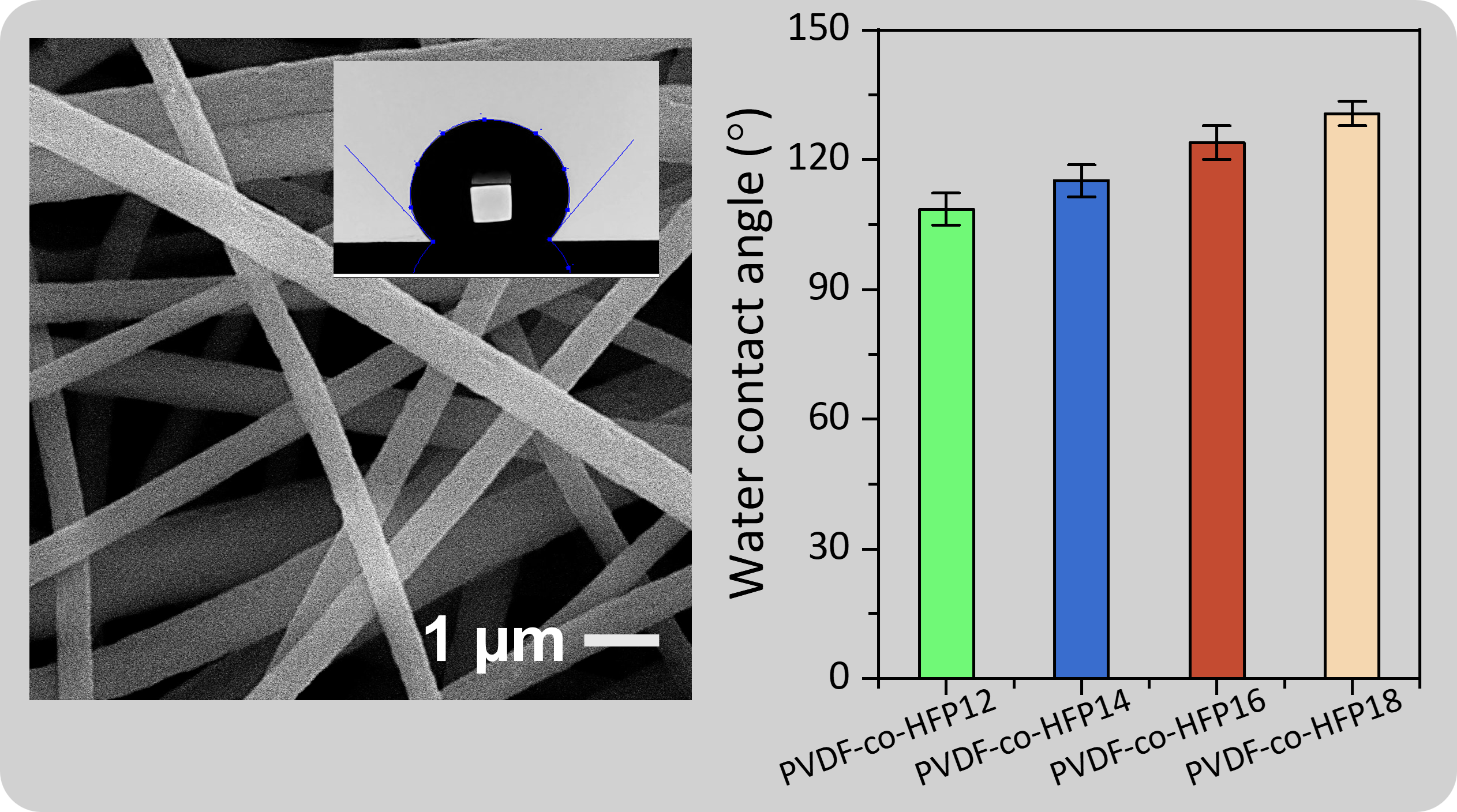
This study investigates the effect of poly(vinylidene fluoride-co-hexafluoropropylene) (PVDF-co-HFP) concentration on the morphological and surface wettability properties of electrospun nanofibers. Nanofiber mats were fabricated using electrospinning with PVDF-co-HFP concentrations ranging from 12 wt% to 18 wt%. Scanning electron microscopy (SEM) analysis revealed that increasing polymer concentration resulted in larger and more uniform fiber diameters, ranging from approximately 235 nm to 560 nm. Fourier-transform infrared (FTIR) spectroscopy confirmed the preservation of the chemical structure, with characteristic peaks associated with CF₂ and C–F groups, and the presence of both α- and β-phases of PVDF. Water contact angle (WCA) measurements indicated a marked increase in hydrophobicity, with WCA values rising from ~108° for PVDF-co-HFP12 to ~128° for PVDF-co-HFP18. This enhancement is attributed to increased surface roughness and fiber diameter, in line with the Cassie–Baxter wetting model. The results demonstrate that polymer concentration is a critical parameter in tailoring nanofiber morphology and wettability, providing a straightforward strategy for designing functional materials in applications such as water-repellent coatings, filtration membranes, and sensing platforms.
Keywords
References
- [1] J. Xue, T. Wu, Y. Dai, Y. Xia, Electrospinning and Electrospun Nanofibers: Methods, Materials, and Applications, Chem Rev 119 (2019) 5298–5415. https://doi.org/10.1021/acs.chemrev.8b00593.
- [2] A.M. Yessuf, M. Bahri, T.S. Kassa, B.P. Sharma, A.M. Salama, C. Xing, Q. Zhang, Y. Liu, Electrospun Polymeric Nanofibers: Current Trends in Synthesis, Surface Modification, and Biomedical Applications, ACS Appl Bio Mater 7 (2024) 4231–4253. https://doi.org/10.1021/acsabm.4c00307.
- [3] D. Ponnamma, O. Aljarod, H. Parangusan, M. Al Ali Al-Maadeed, Electrospun nanofibers of PVDF-HFP composites containing magnetic nickel ferrite for energy harvesting application, Mater Chem Phys 239 (2020) 122257. https://doi.org/10.1016/j.matchemphys.2019.122257.
- [4] Z. Chen, M. Guan, Y. Cheng, H. Li, G. Ji, H. Chen, X. Fu, D.E. Awuye, Y. Zhu, X. Yin, Z. Man, C. Wu, Boehmite-enhanced poly(vinylidene fluoride-co-hexafluoropropylene)/polyacrylonitrile (PVDF-HFP/PAN) coaxial electrospun nanofiber hybrid membrane: a superior separator for lithium-ion batteries, Adv Compos Hybrid Mater 6 (2023) 219. https://doi.org/10.1007/s42114-023-00794-2.
- [5] Y. Zu, Z. Duan, Z. Yuan, Y. Jiang, H. Tai, Electrospun nanofiber-based humidity sensors: materials, devices, and emerging applications, J Mater Chem A Mater 12 (2024) 27157–27179. https://doi.org/10.1039/D4TA05042H.
- [6] B. Subeshan, A. Atayo, E. Asmatulu, Machine learning applications for electrospun nanofibers: a review, J Mater Sci 59 (2024) 14095–14140. https://doi.org/10.1007/s10853-024-09994-7.
- [7] M. Aman Mohammadi, S. Dakhili, A. Mirza Alizadeh, S. Kooki, H. Hassanzadazar, M. Alizadeh-Sani, D.J. McClements, New perspectives on electrospun nanofiber applications in smart and active food packaging materials, Crit Rev Food Sci Nutr 64 (2024) 2601–2617. https://doi.org/10.1080/10408398.2022.2124506.
- [8] U. Duru Kamaci, A. Peksel, Enhanced Catalytic Activity of Immobilized Phytase into Polyvinyl Alcohol-Sodium Alginate Based Electrospun Nanofibers, Catal Letters 151 (2021) 821–831. https://doi.org/10.1007/s10562-020-03339-0.
- [9] V. Beachley, X. Wen, Effect of electrospinning parameters on the nanofiber diameter and length, Materials Science and Engineering: C 29 (2009) 663–668. https://doi.org/10.1016/j.msec.2008.10.037.
- [10] R. Shi, Y. Tian, L. Wang, Bioinspired Fibers with Controlled Wettability: From Spinning to Application, ACS Nano 15 (2021) 7907–7930. https://doi.org/10.1021/acsnano.0c08898.
- [11] A. Raman, J.S. Jayan, B.D.S. Deeraj, A. Saritha, K. Joseph, Electrospun Nanofibers as Effective Superhydrophobic Surfaces: A Brief review, Surfaces and Interfaces 24 (2021) 101140. https://doi.org/10.1016/j.surfin.2021.101140.
- [12] J. Chen, Z.-X. Low, S. Feng, Z. Zhong, W. Xing, H. Wang, Nanoarchitectonics for Electrospun Membranes with Asymmetric Wettability, ACS Appl Mater Interfaces 13 (2021) 60763–60788. https://doi.org/10.1021/acsami.1c16047.
- [13] S.S. Dani, B. Sundaray, S. kumar Nayak, S. Mohanty, Electrospun PVDF and composite nanofiber: Current status and future prescription towards hybrid Piezoelectric nanogenerators, Mater Today Commun 38 (2024) 107661. https://doi.org/10.1016/j.mtcomm.2023.107661.
- [14] F. Mokhtari, A. Samadi, A.O. Rashed, X. Li, J.M. Razal, L. Kong, R.J. Varley, S. Zhao, Recent progress in electrospun polyvinylidene fluoride (PVDF)-based nanofibers for sustainable energy and environmental applications, Prog Mater Sci 148 (2025) 101376. https://doi.org/10.1016/j.pmatsci.2024.101376.
- [15] R. Abdulhussain, A. Adebisi, B.R. Conway, K. Asare-Addo, Electrospun nanofibers: Exploring process parameters, polymer selection, and recent applications in pharmaceuticals and drug delivery, J Drug Deliv Sci Technol 90 (2023) 105156. https://doi.org/10.1016/j.jddst.2023.105156.
- [16] S. Kailasa, M.S.B. Reddy, M.R. Maurya, B.G. Rani, K.V. Rao, K.K. Sadasivuni, Electrospun Nanofibers: Materials, Synthesis Parameters, and Their Role in Sensing Applications, Macromol Mater Eng 306 (2021). https://doi.org/10.1002/mame.202100410.
- [17] K. Karpagavel, K. Sundaramahalingam, A. Manikandan, D. Vanitha, A. Manohar, E.R. Nagarajan, N. Nallamuthu, Electrical Properties of Lithium-Ion Conducting Poly (Vinylidene Fluoride-Co-Hexafluoropropylene) (PVDF-HFP)/Polyvinylpyrrolidone (PVP) Solid Polymer Electrolyte, J Electron Mater 50 (2021) 4415–4425. https://doi.org/10.1007/s11664-021-08967-9.
- [18] V. Eyupoglu, A. Unal, E. Polat, B. Eren, R. Ali Kumbasar, An efficient cobalt separation using PVDF-co-HFP based ultrafiltration polymer inclusion membrane by room temperature ionic liquids, Sep Purif Technol 303 (2022) 122201. https://doi.org/10.1016/j.seppur.2022.122201.
- [19] X. Xing, X. Zhang, M.A.S. Tasin, X. Liang, H. Zhou, H. Niu, Interlaced Amphiphobic Nanofibers for Smart Waterproof and Breathable Membranes with Instant Waterproofness Monitoring Ability, ACS Appl Polym Mater 6 (2024) 7301–7310. https://doi.org/10.1021/acsapm.4c01305.
- [20] Y. Yang, Z. Guo, Y. Li, Y. Qing, P. Dansawad, H. Wu, J. Liang, W. Li, Electrospun rough PVDF nanofibrous membranes via introducing fluorinated SiO2 for efficient oil-water emulsions coalescence separation, Colloids Surf A Physicochem Eng Asp 650 (2022) 129646. https://doi.org/10.1016/j.colsurfa.2022.129646.
- [21] Y. Xiao, F. Xie, H. Luo, R. Tang, J. Hou, Electrospinning SA@PVDF-HFP Core–Shell Nanofibers Based on a Visual Light Transmission Response to Alcohol for Intelligent Packaging, ACS Appl Mater Interfaces 14 (2022) 8437–8447. https://doi.org/10.1021/acsami.1c23055.
- [22] T.U. Rashid, R.E. Gorga, W.E. Krause, Mechanical Properties of Electrospun Fibers—A Critical Review, Adv Eng Mater 23 (2021). https://doi.org/10.1002/adem.202100153.
- [23] F. Russo, R. Castro-Muñoz, S. Santoro, F. Galiano, A. Figoli, A review on electrospun membranes for potential air filtration application, J Environ Chem Eng 10 (2022) 108452. https://doi.org/10.1016/j.jece.2022.108452.
- [24] M. Heinz, P. Stephan, T. Gambaryan-Roisman, Influence of nanofiber coating thickness and drop volume on spreading, imbibition, and evaporation, Colloids Surf A Physicochem Eng Asp 631 (2021) 127450. https://doi.org/10.1016/j.colsurfa.2021.127450.
- [25] A. Rawal, S. Shukla, S. Sharma, D. Singh, Y.-M. Lin, J. Hao, G.C. Rutledge, L. Vásárhelyi, G. Kozma, A. Kukovecz, L. Janovák, Metastable wetting model of electrospun mats with wrinkled fibers, Appl Surf Sci 551 (2021) 149147. https://doi.org/10.1016/j.apsusc.2021.149147.
- [26] J.E. Domínguez, A. Kasiri, J. González‐Benito, Wettability behavior of solution blow spun polysulfone by controlling morphology, J Appl Polym Sci 138 (2021). https://doi.org/10.1002/app.50200.


- Received: May 21, 2025
- Accepted: June 16, 2025
- Published: July 2, 2025
Graphical Abstract