A Novel Fiber Collection System for Rotary Force Spinning Method
- Dian Ahmad Hapidin*

Abstract
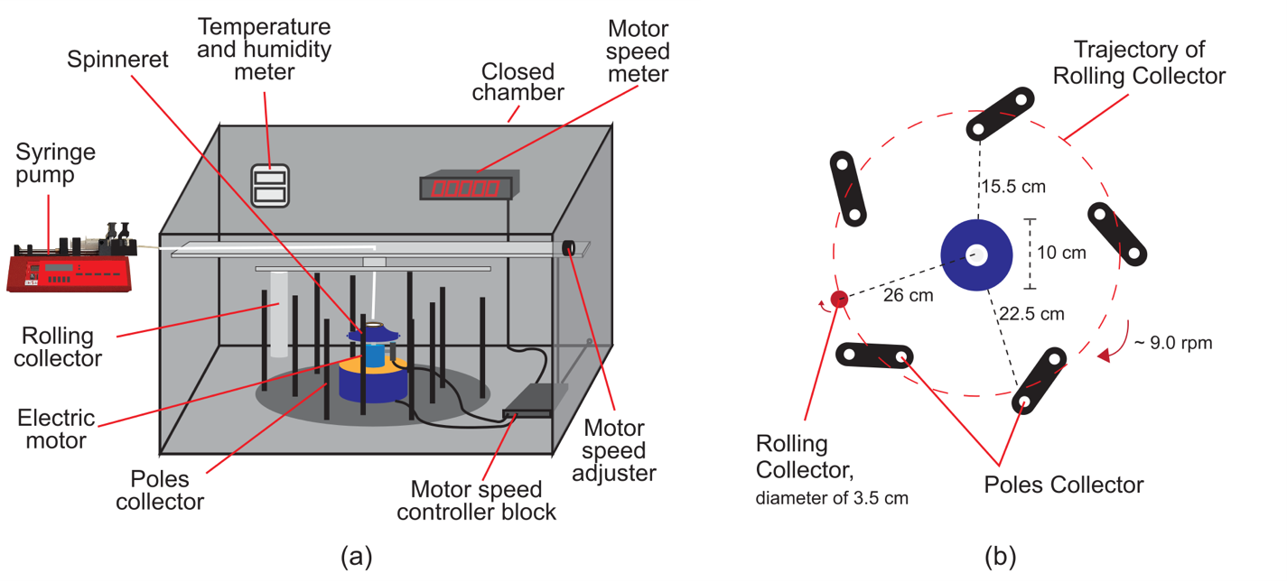
Recent advancements in micro- to nano-scale fiber production, particularly through rotary force spinning (RFS), offer high production rates but face challenges in optimizing fiber collection efficiency. This study investigates the effect of spinneret angular speed on fiber collection performance of a novel RFS collector system. The collector system integrated zig-zag pole collectors with a rolling collector that seamlessly traverse between the poles for fiber assembly. This configuration enabled the produced fibers to be continuously assembled onto the rolling collector, thereby forming fibrous membranes directly during the spinning process. The collection performance was evaluated using polyvinylpyrrolidone (PVP) fibers fabricated at spinneret angular speeds ranging from 4000 to 11000 rpm. The results showed that the rolling collector captured up to 95.39% of the produced fibers at a high rotational speed of 11,000 rpm, whereas at lower rotational speed, most fibers were deposited onto the pole collectors, reaching 95.19% at 4000 rpm. These findings indicate that the proposed collector system effectively enhances fiber collection efficiency over a broad rotational speed range while enabling direct fibrous membrane formation in the RFS process.Keywords
Rotary Forcespinning
nanofiber
Collector
References
- 1. Rogalski J J, Bastiaansen C W M, Peijs T. PA6 Nanofibre Production: A Comparison between Rotary Jet Spinning and Electrospinning. Fibers. 2018;6(2):1-13. https://doi.org/10.3390/fib6020037
- 2. Priyanto A, Hapidin D A, Suciati T, Khairurrijal K. Current developments on rotary forcespun nanofibers and prospects for edible applications. Food Engineering Reviews. 2022;14:435-461. https://doi.org/10.1007/s12393-021-09304-w
- 3. Zhang Z-M, Duan Y-S, Xu Q, Zhang B. A review on nanofiber fabrication with the effect of high-speed centrifugal force field. Journal of Engineered Fibers and Fabrics. 2019;14:1-11. https://doi.org/10.1177/1558925019867517
- 4. Mellado P, McIlwee H A, Badrossamay M R, Goss J A, Mahadevan L, Parker K K. A simple model for nanofiber formation by rotary jet-spinning. Applied Physics Letters. 2011;99:203107. https://doi.org/10.1063/1.3662015
- 5. Priyanto A, Hapidin D A, Khairurrijal K. Potential loading of virgin coconut oil into centrifugally spun nanofibers for biomedical applications. ChemBioEng Reviews. 2022;9:393-408. https://doi.org/10.1002/cben.202100043
- 6. Lu Y, Li Y, Zhang S, Xu G, Fu K, Lee H, Zhang X. Parameter study and characterization for polyacrylonitrile nanofibers fabricated via centrifugal spinning process. European Polymer Journal. 2013;49:3834-3845. https://doi.org/10.1016/j.eurpolymj.2013.08.011
- 7. Priyanto A, Rohman Y M, Hapidin D A, Edikresnha D, Khairurrijal K. Rotary Forcespun Polyvinylpyrrolidone Fibers Matrix Loaded with Virgin Coconut Oil: Physicochemical Characterization, In Vitro Antioxidant Assessment, and Release Profile. Food and Bioprocess Technology. 2024;17:1926-1941. https://doi.org/10.1007/s11947-023-03237-4
- 8. Li Y, Mei S, Dong Y, She F, Kong L. The effect of centrifugal force on the fiber morphology in centrifugal spinning. Polymers. 2019;11:1-13. https://doi.org/10.3390/polym11010017
- 9. Muniz N O, Vechietti F A, Anesi G R, Guinea G V, Santos L A L dos. A review of centrifugal spinning for nanofiber production. Journal of Materials Research. 2020;35:2905-2916. https://doi.org/10.1557/jmr.2020.234
- 10. Edmondson D, Cooper A, Jana S, Wood D, Zhang M. Centrifugal electrospinning of highly aligned polymer nanofibers over a large area. Journal of Materials Chemistry. 2012;22:18646-18652. https://doi.org/10.1039/C2JM33812A
- 11. W. S. Rasband, ImageJ, U.S. National Institutes of Health, Bethesda, MD, USA, 1997–2018. Available at: https://imagej.nih.gov/ij/.
- 12. Zhang X, Lu Y. Centrifugal spinning: An alternative approach to fabricate nanofibers at high speed and low cost. Polymer Reviews. 2014;54:677-701. https://doi.org/10.1080/15583724.2014.935853


Cite this:
Greensusmater.
2026, 3, 1, 06
Publication History
- Received: March 9, 2026
- Accepted: May 14, 2026
- Published: May 25, 2026
DOI: 10.62755/gsm.2026.06
Copyright © 2026 | The Authors. This publication is licensed under
CC-BY 4.0.
Published by Green and Sustainable Materials Society.
Article Views
88
Downloads
0
Citations
Graphical Abstract
Cite
ACM
[1]
Hapidin, D.A. et al. 2026. A Novel Fiber Collection System for Rotary Force Spinning Method. Greensusmater. 3, 1 (May 2026), 06. DOI:https://doi.org/10.62755/gsm.2026.06.
ACS
(1)
Hapidin, D. A.; Ratnasari, E. A.; Priyanto, A.; Khairurrijal, K. A Novel Fiber Collection System for Rotary Force Spinning Method. greensusmater 2026, 3, 06.
APA
Hapidin, D. A., Ratnasari, E. A., Priyanto, A., & Khairurrijal, K. (2026). A Novel Fiber Collection System for Rotary Force Spinning Method. Greensusmater, 3(1), 06. https://doi.org/10.62755/gsm.2026.06
ABNT
HAPIDIN, Dian Ahmad; RATNASARI, Elvina Ayu; PRIYANTO, Aan; KHAIRURRIJAL, Khairurrijal. A Novel Fiber Collection System for Rotary Force Spinning Method. Greensusmater, [S. l.], v. 3, n. 1, p. 06, 2026. DOI: 10.62755/gsm.2026.06. Disponível em: https://greensusmater.com/gsm/article/view/59. Acesso em: 20 oct. 2026.
Chicago
Hapidin, Dian Ahmad, Elvina Ayu Ratnasari, Aan Priyanto, and Khairurrijal Khairurrijal. 2026. “A Novel Fiber Collection System for Rotary Force Spinning Method”. Greensusmater 3 (1):06. https://doi.org/10.62755/gsm.2026.06.
Harvard
Hapidin, D. A. (2026) “A Novel Fiber Collection System for Rotary Force Spinning Method”, Greensusmater, 3(1), p. 06. doi: 10.62755/gsm.2026.06.
IEEE
[1]
D. A. Hapidin, E. A. Ratnasari, A. Priyanto, and K. Khairurrijal, “A Novel Fiber Collection System for Rotary Force Spinning Method”, greensusmater, vol. 3, no. 1, p. 06, May 2026.
MLA
Hapidin, Dian Ahmad, et al. “A Novel Fiber Collection System for Rotary Force Spinning Method”. Greensusmater, vol. 3, no. 1, May 2026, p. 06, doi:10.62755/gsm.2026.06.
Turabian
Hapidin, Dian Ahmad, Elvina Ayu Ratnasari, Aan Priyanto, and Khairurrijal Khairurrijal. “A Novel Fiber Collection System for Rotary Force Spinning Method”. Greensusmater 3, no. 1 (May 25, 2026): 06. Accessed October 20, 2026. https://greensusmater.com/gsm/article/view/59.
Vancouver
1.
Hapidin DA, Ratnasari EA, Priyanto A, Khairurrijal K. A Novel Fiber Collection System for Rotary Force Spinning Method. greensusmater [Internet]. 2026 May 25 [cited 2026 Oct. 20];3(1):06. Available from: https://greensusmater.com/gsm/article/view/59