Cross-linking formation of taro starch (colocasia esculenta)-based hydrogel using freeze-thaw method: synthesis and physical characterization
- William Xaveriano Waresindo

Abstract
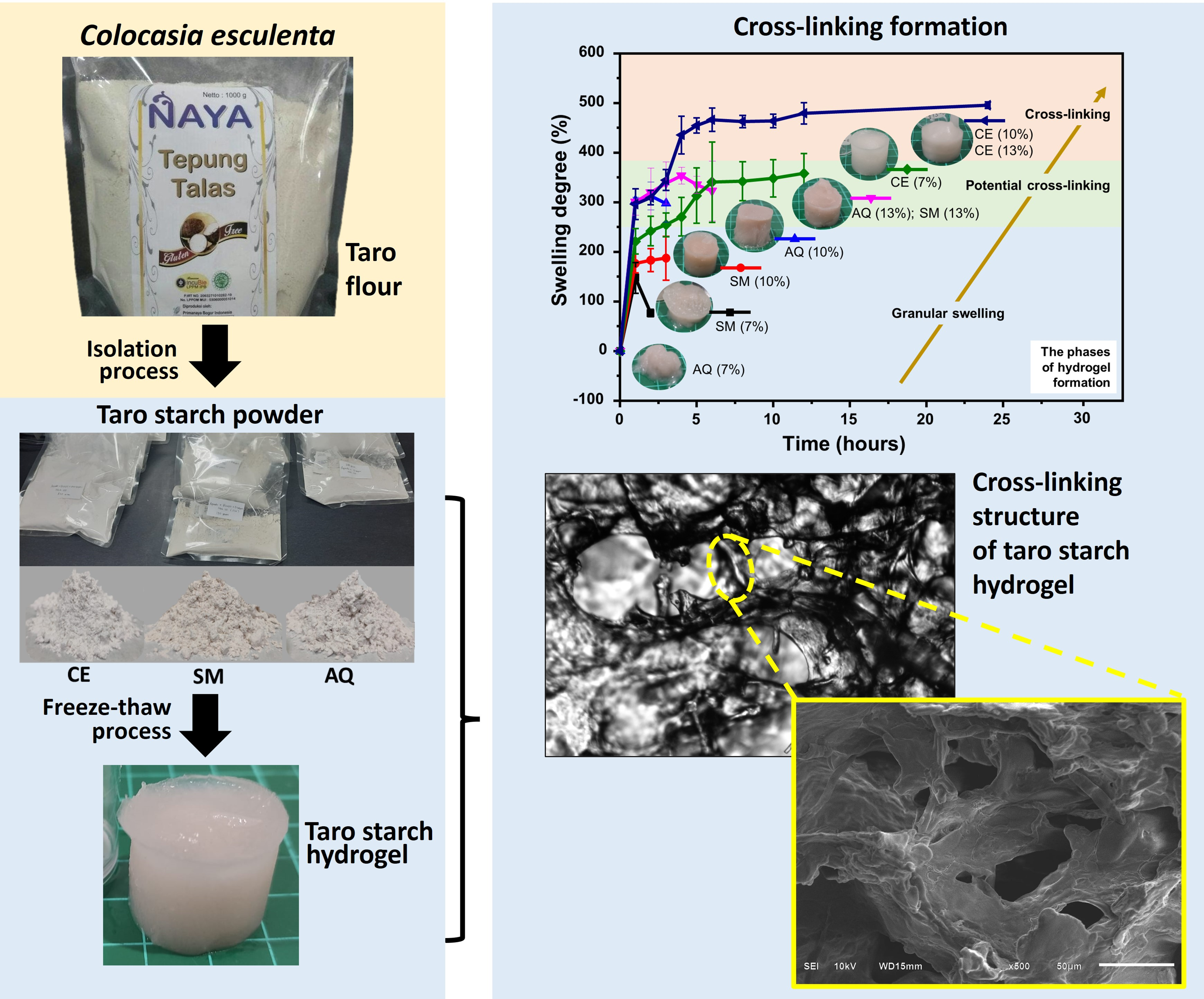
This study successfully made starch from taro tuber flour using immersion methods (AQ, SM) and centrifugation methods (CE). Taro starch with the AQ method produced the most starch content, thus improving the viscosity parameter in the pasting properties test. A simple mathematical model was used to control the taro starch pasting process and product. The highest R-value in the AQ sample was 309.88 s, indicating the strongest starch granule resistance. Meanwhile, the S-value in this study showed that all samples were above 1, which indicated that water penetration affected the swelling rate of starch granules. Taro starch with different isolation methods was analyzed for hydrogel formation using optical microscopy, SEM, swelling degree test, weight loss, color analysis, and texture profile analysis (TPA). The morphological images show three phases of a taro starch hydrogel formation: granular, potential cross-linking, and cross-linking hydrogel with a firm structure. Optimization of freeze-thaw process parameters was carried out to determine the optimum parameters of starch hydrogel formation, which was obtained under freezing conditions for 17 hours at -23°C and thawing for 7 hours at 4°C. The sample CE resulted in the most stable hydrogel formation, showing the highest amylose content, protein content, and the lowest impurities or ash content. The CE starch concentration of 10% resulted in the highest swelling degree and the lowest weight loss, indicating that the ability of the hydrogel to maintain its structure was stronger and more elastic. The textural properties of CE hydrogel at a concentration of 10% showed the most stability. It had the highest hardness, fracturability, chewiness, and springiness. Physical characteristics showed that the starch hydrogels had a dense, porous surface and formed a cross-linking structure. It can potentially be used in functional food applications to control the release of bioactive compounds.
Keywords
References
- [1] P. J. Matthews and M. E. Ghanem, “Perception gaps that may explain the status of taro (Colocasia esculenta) as an ‘orphan crop,’” Plants, People, Planet, vol. 3, no. 2, pp. 99–112, 2021, doi: https://doi.org/10.1002/ppp3.10155.
- [2] T. Mabhaudhi et al., “Prospects of orphan crops in climate change,” Planta, vol. 250, pp. 695–708, 2019, doi: https://doi.org/10.1007/s00425-019-03129-y.
- [3] R. Singh, S. Choudhary, A. K. Verma, and R. Y, Horticulture for Nutrition and Income Security: Taro (Colocasia esculenta (L.) Schoff.) for Nutritional Security and Health Benefits, no. June. New Delhi, India: NIPA (New India Publisher Agency), 2023.
- [4] X. Li, R. Yadav, and K. H. M. Siddique, “Neglected and underutilized crop species: the key to improving dietary diversity and fighting hunger and malnutrition in Asia and the Pacific,” Front. Nutr., vol. 7, p. 593711, 2020, doi: https://doi.org/10.3389/fnut.2020.593711.
- [5] Aditikia, B. Kapoor, S. Singh, P. Kumar, and Others, “Taro (Colocasia esculenta): Zero wastage orphan food crop for food and nutritional security,” South African J. Bot., vol. 145, pp. 157–169, 2022, doi: 10.1016/j.sajb.2021.08.014.
- [6] K. H. M. Siddique, X. Li, and K. Gruber, “Rediscovering Asia’s forgotten crops to fight chronic and hidden hunger,” Nat. Plants, vol. 7, no. 2, pp. 116–122, 2021, doi: https://doi.org/10.1038/s41477-021-00850-z.
- [7] Grand View Research, “Functional Foods Market Size, Share & Trends Analysis Report By Ingredient (Carotenoids, Prebiotics & Probiotics, Fatty Acids, Dietary Fibers), By Product, By Application, By Region, And Segment Forecasts, 2022 - 2030.,” In: Market Analysis Report, 2022. https://www.grandviewresearch.com/industry-analysis/functional-food-market.
- [8] M. N. Saqib, B. M. Khaled, F. Liu, and F. Zhong, “Hydrogel beads for designing future foods: Structures, mechanisms, applications, and challenges,” Food Hydrocoll. Heal., vol. 2, p. 100073, 2022, doi: 10.1016/j.fhfh.2022.100073.
- [9] H. R. Luthfianti et al., “Physicochemical Characteristics and Antibacterial Activities of Freeze-Thawed Polyvinyl Alcohol/Andrographolide Hydrogels,” ACS omega, vol. 8, no. 3, pp. 2915–2930, 2023, doi: 10.1021/acsomega.2c05110.
- [10] W. X. Waresindo, H. R. Luthfianti, D. Edikresnha, T. Suciati, F. A. Noor, and K. Khairurrijal, “A freeze–thaw PVA hydrogel loaded with guava leaf extract: physical and antibacterial properties,” RSC Adv., vol. 11, no. 48, pp. 30156–30171, 2021, doi: 10.1039/d1ra04092h.
- [11] D. Edikresnha, T. Suciati, Suprijadi, and K. Khairurrijal, “Freeze-Thawed Hydrogel Loaded by Piper crocatum Extract with In-Vitro Antibacterial and Release Tests,” J. Mater. Res. Technol., vol. 15, pp. 17–36, 2021, doi: 10.1016/j.jmrt.2021.07.151.
- [12] K. Kusjuriansah et al., “Composite Hydrogel of Poly (vinyl alcohol) Loaded by Citrus hystrix Leaf Extract, Chitosan, and Sodium Alginate with In Vitro Antibacterial and Release Test,” ACS omega, vol. 9, no. 11, pp. 13306–13322, 2024, doi: 10.1021/acsomega.3c10143.
- [13] N. Asy-Syifa, Kusjuriansah, W. X. Waresindo, D. Edikresnha, T. Suciati, and K. Khairurrijal, “The Study of the Swelling Degree of the PVA Hydrogel with varying concentrations of PVA,” J. Phys. Conf. Ser., vol. 2243, no. 1, 2022, doi: 10.1088/1742-6596/2243/1/012053.
- [14] H. Zhang, F. Zhang, and J. Wu, “Physically crosslinked hydrogels from polysaccharides prepared by freeze--thaw technique,” React. Funct. Polym., vol. 73, no. 7, pp. 923–928, 2013, doi: https://doi.org/10.1016/j.reactfunctpolym.2012.12.014.
- [15] C. Cui et al., “Recent advances in the preparation, characterization, and food application of starch-based hydrogels,” Carbohydr. Polym., vol. 291, p. 119624, 2022, doi: 10.1016/j.carbpol.2022.119624.
- [16] N. Singh, J. Singh, L. Kaur, N. S. Sodhi, and B. S. Gill, “Morphological, thermal and rheological properties of starches from different botanical sources,” Food Chem., vol. 81, no. 2, pp. 219–231, 2003, doi: https://doi.org/10.1016/S0308-8146(02)00416-8.
- [17] W. Xiao et al., “Controlling the pasting, rheological, gel, and structural properties of corn starch by incorporation of debranched waxy corn starch,” Food Hydrocoll., vol. 123, p. 107136, 2022, doi: https://doi.org/10.1016/j.foodhyd.2021.107136.
- [18] R. N. Tharanathan, “Biodegradable films and composite coatings: past, present and future,” Trends food Sci. & Technol., vol. 14, no. 3, pp. 71–78, 2003, doi: https://doi.org/10.1016/S0924-2244(02)00280-7.
- [19] R. K. Gupta, P. Guha, and P. P. Srivastav, “Exploring the potential of taro (Colocasia esculenta) starch: Recent developments in modification, health benefits, and food industry applications,” Food Bioeng., vol. 3, no. 3, pp. 365–379, 2024, doi: https://doi.org/10.1002/fbe2.12103.
- [20] P. Vithu, S. K. Dash, K. Rayaguru, M. K. Panda, and M. Nedunchezhiyan, “Optimization of starch isolation process for sweet potato and characterization of the prepared starch,” J. Food Meas. Charact., vol. 14, no. 3, pp. 1520–1532, 2020, doi: 10.1007/s11694-020-00401-8.
- [21] J. B. Zhang et al., “Risk Analysis of Sulfites Used as Food Additives in China,” Biomed. Environ. Sci., vol. 27, no. 2, pp. 147–154, 2014, doi: 10.3967/bes2014.032.
- [22] A. Sawitri et al., “Synthesis and characterization of novel electrospun nanofibers based on taro starch: influence of solvent and isolation agent on morphology and diameter,” Polym. Int., 2024, doi: https://doi.org/10.1002/pi.6709.
- [23] S. S. Behera and R. C. Ray, “Nutritional and potential health benefits of konjac glucomannan, a promising polysaccharide of elephant foot yam, Amorphophallus konjac K. Koch: A review,” Food Rev. Int., vol. 33, no. 1, pp. 22–43, 2017, doi: https://doi.org/10.1080/87559129.2015.1137310.
- [24] A. Ahmed and F. Khan, “Extraction of Starch from Taro (Colocasia esculenta) and Evaluating it and further using Taro Starch as Disintegrating Agent in Tablet Formulation with Over All Evaluation,” Inven. Rapid Nov. Excipients, vol. 2013, no. 2, pp. 1–5, 2013, [Online]. Available: https://www.researchgate.net/publication/263237583.
- [25] W. X. Waresindo, H. Rahmi, and A. Priyanto, “Freeze – thaw hydrogel fabrication method : basic principles , synthesis parameters , properties , and biomedical applications Freeze – thaw hydrogel fabrication method : basic principles , synthesis parameters , properties , and biomedical applications,” Mater. Res. Express, vol. 10, no. 024003, 2023, doi: https://doi.org/10.1088/2053-1591/acb98e.
- [26] I. Palabiyik, O. S. Toker, S. Karaman, and Ö. Yildiz, “A modeling approach in the interpretation of starch pasting properties,” J. Cereal Sci., vol. 74, pp. 272–278, 2017, doi: https://doi.org/10.1016/j.jcs.2017.02.008.
- [27] Z. Chen et al., “Skewed distribution of leaf color RGB model and application of skewed parameters in leaf color description model,” Plant Methods, vol. 16, pp. 1–8, 2020, doi: https://doi.org/10.1186/s13007-020-0561-2.
- [28] X. Zhu, W. Cui, E. Zhang, J. Sheng, X. Yu, and F. Xiong, “Morphological and physicochemical properties of starches isolated from three taro bulbs,” Starch-Stärke, vol. 70, no. 1–2, p. 1700168, 2018, doi: https://doi.org/10.1002/star.201700168.
- [29] M.-G. Dorantes-Fuertes, M. C. López-Méndez, G. Mart’inez-Castellanos, R. Á. Meléndez-Armenta, and H.-E. Jiménez-Mart’inez, “Starch extraction methods in tubers and roots: a systematic review,” Agronomy, vol. 14, no. 4, p. 865, 2024, doi: https://doi.org/10.3390/agronomy14040865.
- [30] O. Paramita, S. Fathonah, Rosidah, T. Agustina, and M. Larasati, “The effect of different processes of flour making on the proximate composition of taro (Colocasia esculenta (l.) flour and taro flour cookies,” IOP Conf. Ser. Earth Environ. Sci., vol. 700, no. 1, 2021, doi: 10.1088/1755-1315/700/1/012065.
- [31] T. Balcha, N. M. Josepha, and A. Beletea, “ISOLATION AND PHYSICOCHEMICAL CHARACTERIZATION OF STARCH FROM TARO BOLOSO-I TUBERS.,” Indian Drugs, vol. 55, no. 7, 2018.
- [32] F. Saputra, A. Hartiati, and B. Admadi, “Karakteristik mutu pati ubi talas (Colocasia esculenta) pada perbandingan air dengan hancuran ubi talas dan konsentrasi natrium metabisulfit,” J. rekayasa dan Manaj. agroindustri, vol. 4, no. 1, pp. 62–71, 2016.
- [33] S. Sonia, E. Julianti, and R. Ridwansyah, “The characteristic of Taro flour based pasta with addition of modified starch and hydrocolloids,” Indones. Food Nutr. Prog., vol. 16, no. 1, pp. 27–35, 2019, doi: 10.22146/ifnp.45681.
- [34] C. K. Nagar, S. K. Dash, K. Rayaguru, U. S. Pal, and M. Nedunchezhiyan, “Isolation, characterization, modification and uses of taro starch: A review,” Int. J. Biol. Macromol., vol. 192, pp. 574–589, 2021, doi: https://doi.org/10.1016/j.ijbiomac.2021.10.041.
- [35] P. R. More, M. I. Talib, and V. R. Parate, “Development of Modified Instant Starch from Taro (Colocasia esculenta) by Gelatinization,” IOSR J. Environ. Sci. Toxicol. Food Technol, vol. 11, pp. 52–59, 2017, doi: 10.9790/2402-1101025259.
- [36] S. Simsek and S. N. El, “Production of resistant starch from taro (Colocasia esculenta L. Schott) corm and determination of its effects on health by in vitro methods,” Carbohydr. Polym., vol. 90, no. 3, pp. 1204–1209, 2012, doi: https://doi.org/10.1016/j.carbpol.2012.06.039.
- [37] S. Sukhija, S. Singh, and C. S. Riar, “Isolation of starches from different tubers and study of their physicochemical, thermal, rheological and morphological characteristics,” Starch-Stärke, vol. 68, no. 1–2, pp. 160–168, 2016, doi: https://doi.org/10.1002/star.201500186.
- [38] E. Pérez, F. S. Schultz, and E. P. de Delahaye, “Characterization of some properties of starches isolated from Xanthosoma sagittifolium (tannia) and Colocassia esculenta (taro),” Carbohydr. Polym., vol. 60, no. 2, pp. 139–145, 2005, doi: https://doi.org/10.1016/j.carbpol.2004.11.033.
- [39] B. Biduski et al., “Starch hydrogels: The influence of the amylose content and gelatinization method,” Int. J. Biol. Macromol., vol. 113, pp. 443–449, 2018, doi: 10.1016/j.ijbiomac.2018.02.144.
- [40] C. D. Bet, C. S. de Oliveira, C. Beninca, T. A. D. Colman, L. G. Lacerda, and E. Schnitzler, “Influence of the addition of hydrocolloids on the thermal, pasting and structural properties of starch from common vetch seeds (Vicia sativa sp),” J. Therm. Anal. Calorim., vol. 133, no. 1, pp. 549–557, 2018, doi: 10.1007/s10973-018-7094-1.
- [41] X. Yu, Y. Zhang, L. Ran, W. Lu, E. Zhang, and F. Xiong, “Accumulation and physicochemical properties of starch in relation to eating quality in different parts of taro (Colocasia esculenta) corm,” Int. J. Biol. Macromol., vol. 194, pp. 924–932, 2022, doi: https://doi.org/10.1016/j.ijbiomac.2021.11.147.
- [42] W. Liang et al., “Investigating the influence of CaCl2 induced surface gelatinization of red adzuki bean starch on its citric acid esterification modification: Structure–property related mechanism,” Food Chem., vol. 436, p. 137724, 2024, doi: https://doi.org/10.1016/j.foodchem.2023.137724.
- [43] B. Karakelle, N. Kian-Pour, O. S. Toker, and I. Palabiyik, “Effect of process conditions and amylose/amylopectin ratio on the pasting behavior of maize starch: A modeling approach,” J. Cereal Sci., vol. 94, p. 102998, 2020, doi: https://doi.org/10.1016/j.jcs.2020.102998.
- [44] Y. Xiao et al., “Effect of different Mesona chinensis polysaccharides on pasting, gelation, structural properties and in vitro digestibility of tapioca starch-Mesona chinensis polysaccharides gels,” Food Hydrocoll., vol. 99, p. 105327, 2020, doi: https://doi.org/10.1016/j.foodhyd.2019.105327.
- [45] B. Shafie, S. C. Cheng, H. H. Lee, and P. H. Yiu, “Characterization and classification of whole-grain rice based on rapid visco analyzer (RVA) pasting profile.,” Int. Food Res. J., vol. 23, no. 5, 2016.
- [46] A. Kaur, N. Singh, R. Ezekiel, and H. S. Guraya, “Physicochemical, thermal and pasting properties of starches separated from different potato cultivars grown at different locations,” Food Chem., vol. 101, no. 2, pp. 643–651, 2007, doi: https://doi.org/10.1016/j.foodchem.2006.01.054.
- [47] S. Varavinit, S. Shobsngob, W. Varanyanond, P. Chinachoti, and O. Naivikul, “Effect of amylose content on gelatinization, retrogradation and pasting properties of flours from different cultivars of Thai rice,” Starch-Stärke, vol. 55, no. 9, pp. 410–415, 2003, doi: 10.1002/star.200300185.
- [48] B. Wang et al., “Structural changes in corn starch granules treated at different temperatures,” Food Hydrocoll., vol. 118, p. 106760, 2021, doi: https://doi.org/10.1016/j.foodhyd.2021.106760.
- [49] H. Dun, H. Liang, S. Li, B. Li, and F. Geng, “Influence of an O/W emulsion on the gelatinization, retrogradation and digestibility of rice starch with varying amylose contents,” Food Hydrocoll., vol. 113, p. 106547, 2021, doi: https://doi.org/10.1016/j.foodhyd.2020.106547.
- [50] A. A. Wani, P. Singh, M. A. Shah, U. Schweiggert-Weisz, K. Gul, and I. A. Wani, “Rice starch diversity: Effects on structural, morphological, thermal, and physicochemical properties—A review,” Compr. Rev. Food Sci. Food Saf., vol. 11, no. 5, pp. 417–436, 2012, doi: https://doi.org/10.1111/j.1541-4337.2012.00193.x.
- [51] R. Juhász and A. Salgó, “Pasting behavior of amylose, amylopectin and their mixtures as determined by RVA curves and first derivatives,” Starch-Stärke, vol. 60, no. 2, pp. 70–78, 2008, doi: https://doi.org/10.1002/star.200700634.
- [52] H. R. Luthfianti et al., “Bioactive Compounds-Loaded Polyvinyl Alcohol Hydrogels: Advancements in Smart Delivery Media for Biomedical Applications,” Mater. Res. Express, vol. 11, p. 062002, 2024, doi: 10.1088/2053-1591/ad4fdd.
- [53] J. Tavakoli, J. Gascooke, N. Xie, B. Z. Tang, and Y. Tang, “Enlightening Freeze–Thaw Process of Physically Cross-Linked Poly(vinyl alcohol) Hydrogels by Aggregation-Induced Emission Fluorogens,” ACS Appl. Polym. Mater., vol. 1, no. 6, pp. 1390–1398, Jun. 2019, doi: 10.1021/acsapm.9b00173.
- [54] M. Moghadam, M. S. S. Dorraji, F. Dodangeh, H. R. Ashjari, S. N. Mousavi, and M. H. Rasoulifard, “Design of a new light curable starch-based hydrogel drug delivery system to improve the release rate of quercetin as a poorly water-soluble drug,” Eur. J. Pharm. Sci., vol. 174, p. 106191, 2022, doi: 10.1016/j.ejps.2022.106191.
- [55] Y. Poyraz, N. Baltaci, G. Hassan, O. Alayoubi, B. Ö. Uysal, and Ö. Pekcan, “Composite Hydrogel of Polyacrylamide/Starch/Gelatin as a Novel Amoxicillin Delivery System,” Gels, vol. 10, no. 10, p. 625, 2024, doi: 10.3390/gels10100625.
- [56] W. Zhang, H. Chen, J. Wang, Y. Wang, L. Xing, and H. Zhang, “Physicochemical properties of three starches derived from potato, chestnut, and yam as affected by freeze-thaw treatment,” Starch/Staerke, vol. 66, no. 3–4, pp. 353–360, 2014, doi: 10.1002/star.201200270.
- [57] T. Jiang, Q. Duan, J. Zhu, H. Liu, and L. Yu, “Starch-based biodegradable materials: Challenges and opportunities,” Adv. Ind. Eng. Polym. Res., vol. 3, no. 1, pp. 8–18, 2020, doi: 10.1016/j.aiepr.2019.11.003.
- [58] M. Sunyoto, M. Djali, and A. F. Rizky, “Study on the Physical Characteristics of Macaroni Made of Cassava Waste and Corn Flour by Applying Different Sizes of Die Extruder and Frequency of Moulding,” KnE Life Sci., vol. 2, no. 6, p. 542, 2017, doi: 10.18502/kls.v2i6.1074.
- [59] M. Rodhiyah et al., “Exploring freeze-thawed cellulose-based hydrogel from corn Cob: Physicochemical properties, antibacterial activity, and cytotoxicity assay,” Biocatal. Agric. Biotechnol., vol. 67, p. 103629, 2025, doi: 10.1016/j.bcab.2025.103629.
- [60] N. Nafisah et al., “Enhanced Superabsorbency of Cellulose-Based Hydrogels in NaOH Solution: Synthesis, Characterization, and Performance Evaluation,” in Journal of Physics: Conference Series, 2024, vol. 2734, no. 1, p. 12036, doi: 10.1088/1742-6596/2734/1/012036.
- [61] W. X. Waresindo et al., “Extraction and characterization of glucomannan from young porang tubers (Amorphophallus muelleri Blume) and its hydrogel formation for potential application in functional foods,” J. Food Sci. Technol., pp. 1–12, 2025, doi: 10.1007/s13197-025-06312-0.
- [62] A. Hassan, M. B. K. Niazi, A. Hussain, S. Farrukh, and T. Ahmad, “Development of Anti-bacterial PVA/Starch Based Hydrogel Membrane for Wound Dressing,” J. Polym. Environ., vol. 26, no. 1, pp. 235–243, 2018, doi: 10.1007/s10924-017-0944-2.
- [63] C. Yu, X. Tang, S. Liu, Y. Yang, X. Shen, and C. Gao, “Laponite crosslinked starch/polyvinyl alcohol hydrogels by freezing/thawing process and studying their cadmium ion absorption,” Int. J. Biol. Macromol., vol. 117, pp. 1–6, 2018, doi: 10.1016/j.ijbiomac.2018.05.159.
- [64] A. Dafe, H. Etemadi, A. Dilmaghani, and G. R. Mahdavinia, “Investigation of pectin/starch hydrogel as a carrier for oral delivery of probiotic bacteria,” Int. J. Biol. Macromol., vol. 97, pp. 536–543, 2017, doi: 10.1016/j.ijbiomac.2017.01.060.
- [65] Q. Zhang, Y. Liu, G. Yang, H. Kong, L. Guo, and G. Wei, “Recent advances in protein hydrogels: From design, structural and functional regulations to healthcare applications,” Chem. Eng. J., vol. 451, p. 138494, 2023, doi: https://doi.org/10.1016/j.cej.2022.138494.
- [66] H. Li, N. Kong, B. Laver, and J. Liu, “Hydrogels constructed from engineered proteins,” Small, vol. 12, no. 8, pp. 973–987, 2016, doi: https://doi.org/10.1002/smll.201502429.
- [67] D. Wu and D.-W. Sun, “Colour measurements by computer vision for food quality control--A review,” Trends Food Sci. & Technol., vol. 29, no. 1, pp. 5–20, 2013, doi: https://doi.org/10.1016/j.tifs.2012.08.004.
- [68] P. S. Hornung et al., “Enhancement of the functional properties of Dioscoreaceas native starches: Mixture as a green modification process,” Thermochim. Acta, vol. 649, pp. 31–40, 2017, doi: https://doi.org/10.1016/j.tca.2017.01.006.
- [69] J. Rożnowski, L. Juszczak, B. Szwaja, and I. Przetaczek-Rożnowska, “Effect of Esterification Conditions on the Physicochemical Properties of Phosphorylated Potato Starch,” Polymers (Basel)., vol. 13, no. 15, p. 2548, 2021, doi: 10.3390/polym13152548.
- [70] J. F. Douglas and F. Horkay, “Influence of swelling on the elasticity of polymer networks cross-linked in the melt state: Test of the localization model of rubber elasticity,” J. Chem. Phys., vol. 160, no. 22, 2024, doi: https://doi.org/10.1063/5.0212901.
- [71] G. Wu, C. F. Morris, and K. M. Murphy, “Quinoa starch characteristics and their correlations with the texture profile analysis (TPA) of cooked quinoa,” J. Food Sci., vol. 82, no. 10, pp. 2387–2395, 2017, doi: 10.1111/1750-3841.13848.
- [72] Y. Sun et al., “Gelatinization, pasting, and rheological properties of pea starch in alcohol solution,” Food Hydrocoll., vol. 112, p. 106331, 2021, doi: 10.1016/j.foodhyd.2020.106331.

- Received: July 1, 2025
- Accepted: September 29, 2025
- Published: December 1, 2025
Graphical Abstract