Archives
-
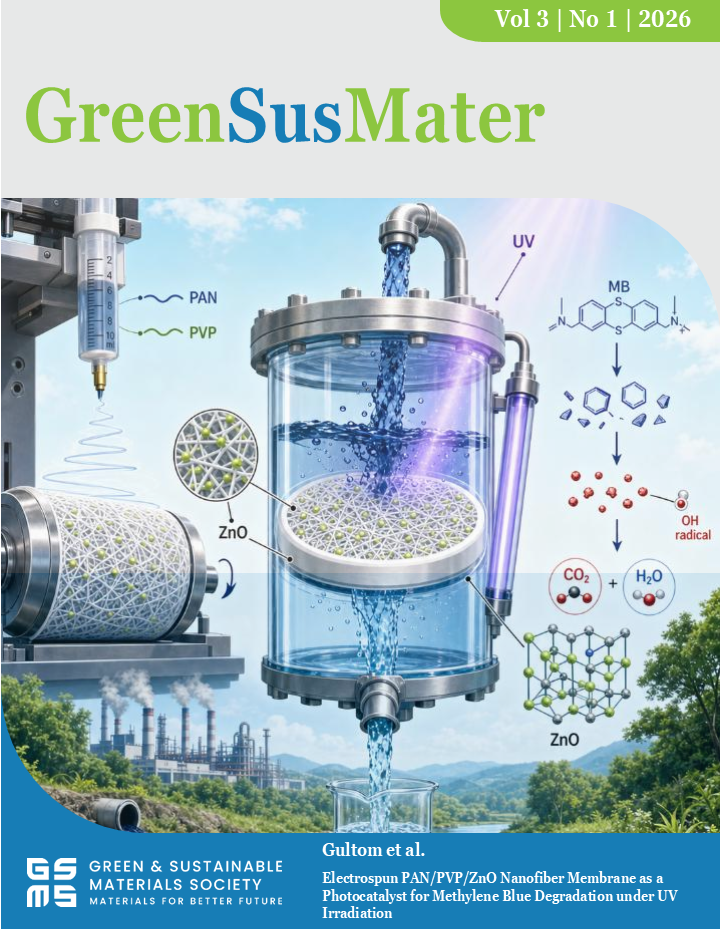 Vol 3 / No 1 (2026)
Vol. 3 No. 1 (2026)
This issue presents six contributions that span three closely connected fronts of sustainable-materials research. A first group addresses water-pollution control, examining how advanced photocatalysts and adsorbents can be engineered to remove organic dyes and pharmaceutical residues from aqueous systems. A second group focuses on nanofiber and membrane fabrication science, where electrospinning and related techniques are used to translate active materials into self-standing, retrievable architectures suitable for repeated deployment. A third contribution extends the issue's scope toward energy conversion, using device-level simulation to map optimization pathways for next-generation thin-film photovoltaics.
Read together, these papers reflect a shared methodological outlook: the deliberate pairing of materials design with operational practicality — recoverability, scalability, and device-level performance — that increasingly defines sustainable-materials engineering. They also illustrate the field's growing tendency to treat fabrication strategy, material composition, and end-use performance as a single integrated design problem rather than as separate optimization steps. -
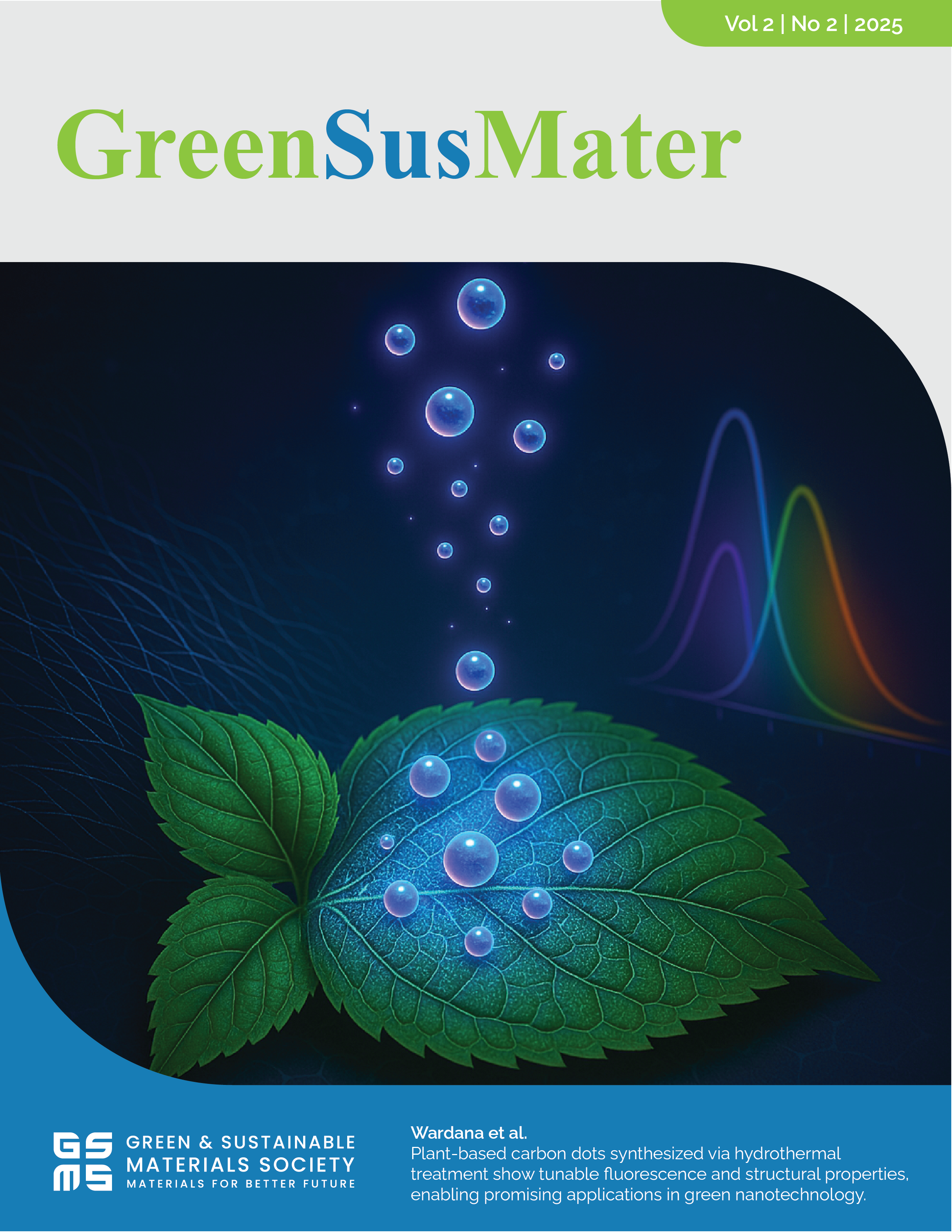 Vol 2 / No 2 (2025)
Vol. 2 No. 2 (2025)
The second issue of Greensusmater in 2025 brings together innovative research at the intersection of materials science, environmental sustainability, and nanotechnology. This edition highlights how materials design and modification can enhance performance in diverse applications—ranging from wastewater treatment to energy storage. This volume features studies on tailoring crystallinity and magnetism of SiO₂@NiZnFe₂O₄ nanoparticles via thermal annealing, hydrogel synthesis from natural taro starch using a freeze-thaw method, and eco-friendly carbon dots synthesized from plant extracts. Additionally, readers will find advanced investigations on niobium-doped BiVO₄ for photocatalytic degradation of antibiotics and dyes, as well as molybdenum-doped Nb₂O₅ electrodes for high-performance supercapacitors. Together, these contributions reinforce the journal's commitment to green, functional, and sustainable materials research.
-
 Vol 2 / No 1 (2025)
Vol. 2 No. 1 (2025)
This issue of Greensusmater (Vol. 2 No. 1, 2025) presents a collection of studies at the intersection of sustainable materials science and environmental engineering. The highlighted works explore advanced nanofiber membranes for dye and fatty acid removal, including zeolite-enhanced PAN/PVDF composites and edible bird’s nest-derived nanofibers. Other contributions delve into the optimization of PVDF-co-HFP polymer systems for tunable membrane properties and activated carbon from natural biomass for cooking oil purification. A theoretical study on k-point mesh density for accurate DFT modeling of graphene rounds out the issue, offering a balanced perspective of experimental and computational advancements.
-
 Vol 1 / No 2 (2024)
Vol. 1 No. 2 (2024)
This issue focuses on innovative research in developing materials for water treatment, highlighting sustainable solutions that address pressing environmental challenges. The featured articles explore various topics, including Advanced filtration technology, nanotechnology applications, photocatalytic processes, and sustainable materials development. The issue serves as a platform for showcasing cutting-edge research that merges material science with environmental engineering, emphasizing innovation and practicality in tackling global water challenges. It aims to inspire interdisciplinary collaboration and drive advancements in the pursuit of green and sustainable solutions.
-
 Vol 1 / No 1 (2024)
Inaugural issue
We are proud to present the inaugural issue of Green and Sustainable Materials, showcasing cutting-edge research on innovative materials designed to address environmental challenges. This issue features a collection of original studies and reviews that highlight the development, characterization, and application of green and sustainable materials in environmental remediation.