Abstract
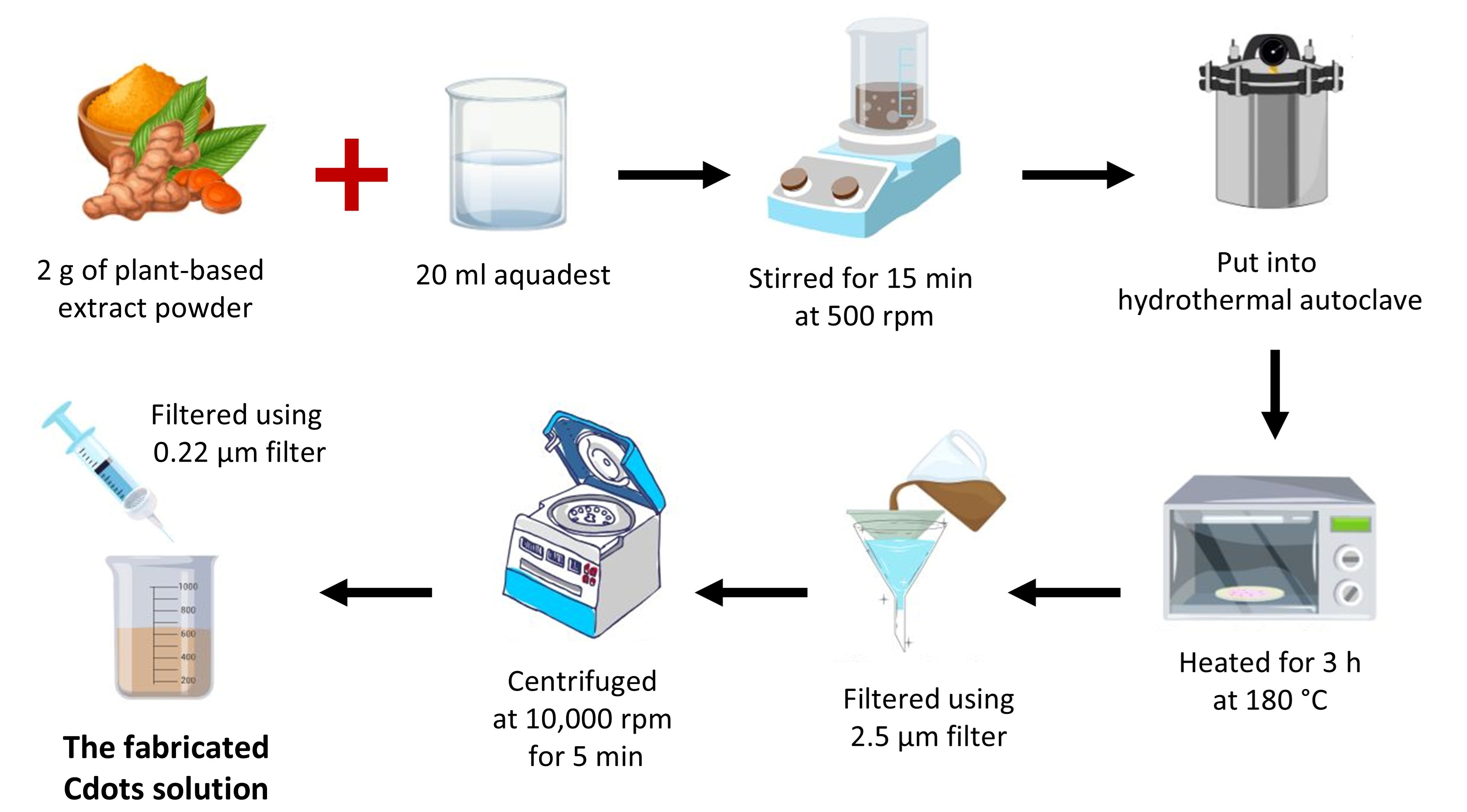
Cdots are carbon-based nanoparticles and luminescent materials that are safe for humans, the environment, and have many potential applications. Natural precursors using local plants can be utilized, and a green synthesis approach can be used to fabricate Cdots that are advantageous in terms of sustainability, availability, low cost, and minimal toxic waste. In this study, the hydrothermal method was chosen because the process is simple, does not require a catalyst, and is suitable for natural materials. The fabricated Cdots from various plant-based extract precursors using the hydrothermal method are investigated for the chemical and optical property changes that occur during the conversion of natural extracts into Cdots. Fourier-transform infrared (FTIR) spectra show that functional groups such as O–H and C=C remain present after the Cdots synthesis process. The UV-Vis spectra show a shift in the absorption band, indicating the formation of sp² aromatic domains and π-π* transition in the Cdots structure, compared to plant-based extracts. These results show great potential of local plants as base material for producing Cdots that can be beneficial for various applications.
Keywords
References
- 1. Gong Q, Chun Wong H, Chen J, Li P, Lu L (2024) Solar-driven adaptive radiative cooling coating with polymer carbon dots-enhanced photoluminescence for urban skin. Chem Eng J 494:153262. https://doi.org/https://doi.org/10.1016/j.cej.2024.153262
- 2. Sobhanan J, Rival J V, Anas A, Sidharth Shibu E, Takano Y, Biju V (2023) Luminescent quantum dots: Synthesis, optical properties, bioimaging and toxicity. Adv Drug Deliv Rev 197:114830. https://doi.org/https://doi.org/10.1016/j.addr.2023.114830
- 3. Hu L, Zhong H, He Z (2021) Toxicity evaluation of cadmium-containing quantum dots: A review of optimizing physicochemical properties to diminish toxicity. Colloids Surfaces B Biointerfaces 200:111609. https://doi.org/https://doi.org/10.1016/j.colsurfb.2021.111609
- 4. Mo D, Hu L, Zeng G, Chen G, Wan J, Yu Z, Huang Z, He K, Zhang C, Cheng M (2017) Cadmium-containing quantum dots: properties, applications, and toxicity. Appl Microbiol Biotechnol 101:2713–2733. https://doi.org/10.1007/s00253-017-8140-9
- 5. Li KG, Chen JT, Bai SS, Wen X, Song SY, Yu Q, Li J, Wang YQ (2009) Intracellular oxidative stress and cadmium ions release induce cytotoxicity of unmodified cadmium sulfide quantum dots. Toxicol Vitr 23:1007–1013. https://doi.org/https://doi.org/10.1016/j.tiv.2009.06.020
- 6. Fu M, Critchley K (2024) Inkjet printing of heavy-metal-free quantum dots-based devices: a review. Nanotechnology 35:302002. https://doi.org/10.1088/1361-6528/ad40b3
- 7. Geng L, Wang H, Liu M, Huang J, Wang G, Guo Z, Guo Y, Sun X (2024) Research progress on preparation methods and sensing applications of molecularly imprinted polymer-aptamer dual recognition elements. Sci Total Environ 912:168832. https://doi.org/https://doi.org/10.1016/j.scitotenv.2023.168832
- 8. Pourmadadi M, Rahmani E, Rajabzadeh-Khosroshahi M, Samadi A, Behzadmehr R, Rahdar A, Ferreira LFR (2023) Properties and application of carbon quantum dots (CQDs) in biosensors for disease detection: A comprehensive review. J Drug Deliv Sci Technol 80:104156. https://doi.org/https://doi.org/10.1016/j.jddst.2023.104156
- 9. Desmond LJ, Phan AN, Gentile P (2021) Critical overview on the green synthesis of carbon quantum dots and their application for cancer therapy. Environ Sci Nano 8:848–862. https://doi.org/10.1039/D1EN00017A
- 10. Emam HE (2024) Carbon quantum dots derived from polysaccharides: Chemistry and potential applications. Carbohydr Polym 324:121503. https://doi.org/https://doi.org/10.1016/j.carbpol.2023.121503
- 11. Gidwani B, Sahu V, Shukla SS, Pandey R, Joshi V, Jain VK, Vyas A (2021) Quantum dots: Prospectives, toxicity, advances and applications. J Drug Deliv Sci Technol 61:102308. https://doi.org/https://doi.org/10.1016/j.jddst.2020.102308
- 12. Eller B, Clark CW, Wang Y (2025) Scaling law of quantum confinement in single-walled carbon nanotubes. J Chem Phys 162:144303. https://doi.org/10.1063/5.0245889
- 13. Li W, Wang X, Lin J, Meng X, Wang L, Wang M, Jing Q, Song Y, Vomiero A, Zhao H (2024) Controllable and large-scale synthesis of carbon quantum dots for efficient solid-state optical devices. Nano Energy 122:109289. https://doi.org/https://doi.org/10.1016/j.nanoen.2024.109289
- 14. Sangjan A, Boonsith S, Sansanaphongpricha K, Thinbanmai T, Ratchahat S, Laosiripojana N, Wu KC-W, Shin HS, Sakdaronnarong C (2022) Facile preparation of aqueous-soluble fluorescent polyethylene glycol functionalized carbon dots from palm waste by one-pot hydrothermal carbonization for colon cancer nanotheranostics. Sci Rep 12:10550. https://doi.org/10.1038/s41598-022-14704-x
- 15. Zhong L, Liu W, Xie Z, Liu J (2024) Biomimetic synthesis of RPL14B-based CdSe quantum dots for the detection of heavy metal copper ions. RSC Adv 14:16821–16827. https://doi.org/10.1039/D4RA02022G
- 16. Sari EK, Tumbelaka RM, Ardiyanti H, Istiqomah NI, Chotimah, Suharyadi E (2023) Green synthesis of magnetically separable and reusable Fe3O4/Cdots nanocomposites photocatalyst utilizing Moringa oleifera extract and watermelon peel for rapid dye degradation. Carbon Resour Convers 6:274–286. https://doi.org/https://doi.org/10.1016/j.crcon.2023.04.003
- 17. Nath N, Kumar A, Chakroborty S, Soren S, Barik A, Pal K, de Souza FGJ (2023) Carbon Nanostructure Embedded Novel Sensor Implementation for Detection of Aromatic Volatile Organic Compounds: An Organized Review. ACS Omega 8:4436–4452. https://doi.org/10.1021/acsomega.2c05953
- 18. Dhumal P, Chakraborty S, Ibrahim B, Kaur M, Valsami-Jones E (2024) Green-synthesised carbon nanodots: A SWOT analysis for their safe and sustainable innovation. J Clean Prod 480:144115. https://doi.org/https://doi.org/10.1016/j.jclepro.2024.144115
- 19. Rahman MM, Maniruzzaman M, Yeasmin MS (2023) A state-of-the-art review focusing on the significant techniques for naturally available fibers as reinforcement in sustainable bio-composites: Extraction, processing, purification, modification, as well as characterization study. Results Eng 20:101511. https://doi.org/https://doi.org/10.1016/j.rineng.2023.101511
- 20. Bressi V, Balu AM, Iannazzo D, Espro C (2023) Recent advances in the synthesis of carbon dots from renewable biomass by high-efficient hydrothermal and microwave green approaches. Curr Opin Green Sustain Chem 40:100742. https://doi.org/https://doi.org/10.1016/j.cogsc.2022.100742
- 21. Abdalla JA, Hawileh RA, Bahurudeen A, Jyothsna G, Sofi A, Shanmugam V, Thomas BS (2023) A comprehensive review on the use of natural fibers in cement/geopolymer concrete: A step towards sustainability. Case Stud Constr Mater 19:e02244. https://doi.org/https://doi.org/10.1016/j.cscm.2023.e02244
- 22. Liu W, Cui X, Zhong Y, Ma R, Liu B, Xia Y (2023) Phenolic metabolites as therapeutic in inflammation and neoplasms: Molecular pathways explaining their efficacy. Pharmacol Res 193:106812. https://doi.org/https://doi.org/10.1016/j.phrs.2023.106812
- 23. Yang X, Miao X, Dai L, Guo X, Jenis J, Zhang J, Shang X (2024) Isolation, biological activity, and synthesis of isoquinoline alkaloids. Nat Prod Rep 41:1652–1722. https://doi.org/10.1039/D4NP00023D
- 24. Bulla M, Kumar V, Devi R, Kumar S, Dahiya R, Singh P, Mishra AK (2024) Exploring the frontiers of carbon nanotube synthesis techniques and their potential applications in supercapacitors, gas sensing, and water purification. J Environ Chem Eng 12:114504. https://doi.org/https://doi.org/10.1016/j.jece.2024.114504
- 25. Ye F, Musselman KP (2024) Synthesis of low dimensional nanomaterials by pulsed laser ablation in liquid. APL Mater 12:50602. https://doi.org/10.1063/5.0199104
- 26. Rocco D, Moldoveanu VG, Feroci M, Bortolami M, Vetica F (2023) Electrochemical Synthesis of Carbon Quantum Dots. ChemElectroChem 10:e202201104. https://doi.org/https://doi.org/10.1002/celc.202201104
- 27. Fawaz W, Hasian J, Alghoraibi I (2023) Synthesis and physicochemical characterization of carbon quantum dots produced from folic acid. Sci Rep 13:18641. https://doi.org/10.1038/s41598-023-46084-1
- 28. Baragau I-A, Lu Z, Power NP, Morgan DJ, Bowen J, Diaz P, Kellici S (2021) Continuous hydrothermal flow synthesis of S-functionalised carbon quantum dots for enhanced oil recovery. Chem Eng J 405:126631. https://doi.org/https://doi.org/10.1016/j.cej.2020.126631
- 29. Hebbar A, Selvaraj R, Vinayagam R, Varadavenkatesan T, Kumar PS, Duc PA, Rangasamy G (2023) A critical review on the environmental applications of carbon dots. Chemosphere 313:137308. https://doi.org/https://doi.org/10.1016/j.chemosphere.2022.137308
- 30. Li Z, Peng K, Ji N, Zhang W, Tian W, Gao Z (2025) Advanced mechanisms and applications of microwave-assisted synthesis of carbon-based materials: a brief review. Nanoscale Adv 7:419–432. https://doi.org/10.1039/D4NA00701H
- 31. Widiyandari H, Pratama ED, Parasdila H, Suryana R, Arutanti O, Astuti Y (2023) Synthesis of ZnO-Cdots nanoflower by hydrothermal method for antibacterial agent and dye photodegradation catalyst. Results Mater 20:100491. https://doi.org/https://doi.org/10.1016/j.rinma.2023.100491
- 32. Chen Z, Guo Y, Luo L, Liu Z, Miao W, Xia Y (2024) A critical review of hydrochar based photocatalysts by hydrothermal carbonization: synthesis, mechanisms, and applications. Biochar 6:74. https://doi.org/10.1007/s42773-024-00364-9
- 33. Yue J, Li L, Cao L, Zan M, Yang D, Wang Z, Chang Z, Mei Q, Miao P, Dong W-F (2019) Two-Step Hydrothermal Preparation of Carbon Dots for Calcium Ion Detection. ACS Appl Mater Interfaces 11:44566–44572. https://doi.org/10.1021/acsami.9b13737
- 34. Tariq M, Shivalkar S, Hasan H, Sahoo AK, Sk MP (2023) Manganese Doping in Biomass Derived Carbon Dots Amplifies White Light-Induced Antibacterial Activity. ACS Omega 8:49460–49466. https://doi.org/10.1021/acsomega.3c08586
- 35. Wongsa P, Phatikulrungsun P, Prathumthong S (2022) FT-IR characteristics, phenolic profiles and inhibitory potential against digestive enzymes of 25 herbal infusions. Sci Rep 12:6631. https://doi.org/10.1038/s41598-022-10669-z
- 36. Ramli M, Sujoko I, Adhha N, Annas D, Nikmatullah M, Ariyanta HA, Apriandanu DOB, Saputra IS, Khairurrijal K (2024) Influence of various concentrations of chloroauric acid on the fabrication of gold nanoparticles: Green synthesis using Elaeis guineensis Jacq leaf extract and characterizations. Results in Surfaces and Interfaces 17:100317. https://doi.org/https://doi.org/10.1016/j.rsurfi.2024.100317
- 37. Bolade OP, Williams AB, Benson NU (2021) Dataset on analytical characterization of bioactive components from Azadirachta indica, Canna indica, Magnifera indica and Moringa oleifera leaf extracts and their applications in nanoparticles biosynthesis. Data Br 38:107407. https://doi.org/https://doi.org/10.1016/j.dib.2021.107407
- 38. Visheratina A, Hesami L, Wilson AK, Baalbaki N, Noginova N, Noginov MA, Kotov NA (2022) Hydrothermal synthesis of chiral carbon dots. Chirality 34:1503–1514. https://doi.org/https://doi.org/10.1002/chir.23509
- 39. Mohammed SJ, Omer KM, Hawaiz FE (2023) Deep insights to explain the mechanism of carbon dot formation at various reaction times using the hydrothermal technique: FT-IR, 13C-NMR, 1H-NMR, and UV-visible spectroscopic approaches. RSC Adv 13:14340–14349. https://doi.org/10.1039/D3RA01646C
- 40. Yang Q, Wei L, Zheng X, Xiao L (2015) Single Particle Dynamic Imaging and Fe3+ Sensing with Bright Carbon Dots Derived from Bovine Serum Albumin Proteins. Sci Rep 5:17727. https://doi.org/10.1038/srep17727
- 41. Al Farsi B, Sofin RGS, Al Shidhani H, El-Shafey E-SI, Al-Hosni AS, Al Marzouqi F, Issac A, Al Nabhani A, Abou-Zied OK (2022) The effect of microwave power level and post-synthesis annealing treatment on oxygen-based functional groups present on carbon quantum dots. J Lumin 252:119326. https://doi.org/https://doi.org/10.1016/j.jlumin.2022.119326
- 42. Dong X, Liang W, Meziani MJ, Sun Y-P, Yang L (2020) Carbon Dots as Potent Antimicrobial Agents. Theranostics 10:671–686. https://doi.org/10.7150/thno.39863
- 43. Miao S, Liang K, Zhu J, Yang B, Zhao D, Kong B (2020) Hetero-atom-doped carbon dots: Doping strategies, properties and applications. Nano Today 33:100879. https://doi.org/https://doi.org/10.1016/j.nantod.2020.100879
- 44. da Silva AO, Rodrigues MO, Sousa MH, Campos AFC (2021) pH-Dependent surface properties of N–Cdots obtained by the hydrothermal method with multicolored emissions. Colloids Surfaces A Physicochem Eng Asp 621:126578. https://doi.org/https://doi.org/10.1016/j.colsurfa.2021.126578
- 45. Ludin NA, Al-Alwani MAM, Mohamad AB, Kadhum AAH, Hamid NH, Ibrahim MA, Teridi MAM, Ali Al-Hakeem TM, Mukhlus A, Sopian K (2018) Utilization of Natural Dyes from Zingiber officinale Leaves and Clitoria ternatea Flowers to Prepare New Photosensitisers for Dye-Sensitised Solar Cells. Int J Electrochem Sci 13:7451–7465. https://doi.org/https://doi.org/10.20964/2018.08.04
- 46. Anouar EH, Gierschner J, Duroux J-L, Trouillas P (2012) UV/Visible spectra of natural polyphenols: A time-dependent density functional theory study. Food Chem 131:79–89. https://doi.org/https://doi.org/10.1016/j.foodchem.2011.08.034
- 47. Li X, Yan L, Si J, Xu H, Xu Y (2019) Tuning the photoluminescence property of carbon dots by ultraviolet light irradiation. RSC Adv 9:12732–12736. https://doi.org/10.1039/C9RA02080B
- 48. Gedda G, Sankaranarayanan SA, Putta CL, Gudimella KK, Rengan AK, Girma WM (2023) Green synthesis of multi-functional carbon dots from medicinal plant leaves for antimicrobial, antioxidant, and bioimaging applications. Sci Rep 13:6371. https://doi.org/10.1038/s41598-023-33652-8
- 49. Ponnusamy A, Murugan G, Mittal A, Saetang J, Prodpran T, Rhim J-W, Benjakul S (2025) Carbon Dots Derived from Polyphenols by Hydrothermal Carbonization: Spectral, Antioxidant, and Antimicrobial Properties and Cytotoxicity Assessment. Food Biophys 20:89. https://doi.org/10.1007/s11483-025-09983-6
- 50. Meng W, Bai X, Wang B, Liu Z, Lu S, Yang B (2019) Biomass-Derived Carbon Dots and Their Applications. ENERGY Environ Mater 2:172–192. https://doi.org/https://doi.org/10.1002/eem2.12038
- 51. Yamaguchi Y, Matsubara Y, Ochi T, Wakamiya T, Yoshida Z (2008) How the π Conjugation Length Affects the Fluorescence Emission Efficiency. J Am Chem Soc 130:13867–13869. https://doi.org/10.1021/ja8040493

- Received: July 19, 2025
- Accepted: October 31, 2025
- Published: December 1, 2025
Graphical Abstract