Abstract
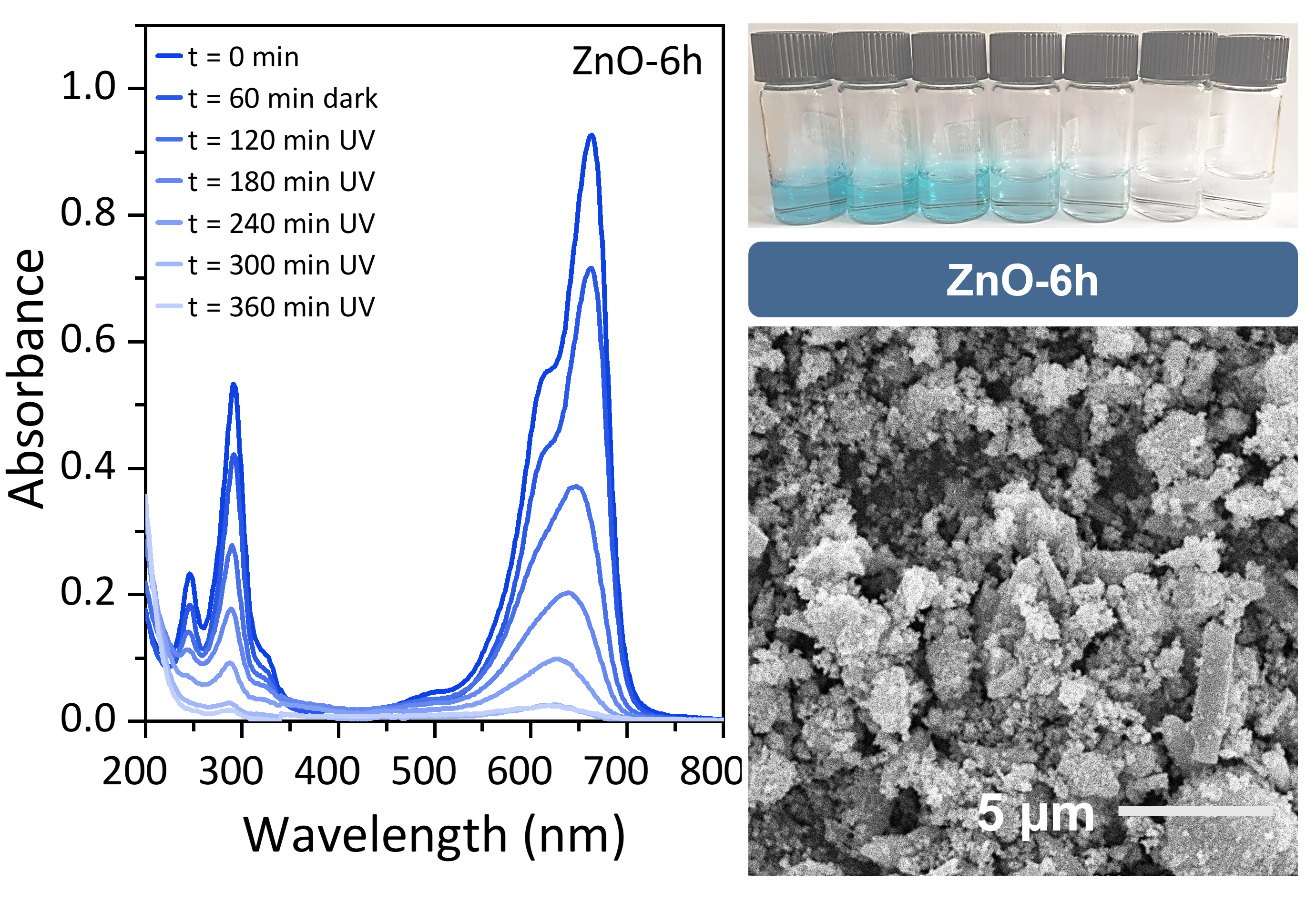
The increasing prevalence of organic pollutants in wastewater poses a significant environmental challenge due to their persistence and harmful effects. Photocatalysis using semiconductor nanoparticles, such as ZnO, has emerged as a promising approach for pollutant degradation, but optimizing the structural and functional properties of these materials remains a critical challenge. In this study, ZnO nanoparticles were synthesized via a hydrothermal method with varying durations (4, 6, and 8 hours) to investigate the impact of synthesis time on their photocatalytic efficiency. The structural and compositional properties were characterized using SEM, XRD, and EDS analyses, revealing that longer synthesis times improve crystallinity and alter the Zn:O atomic ratio, affecting defect density and stoichiometry. Photocatalytic performance was evaluated through the degradation of an organic pollutant under UV illumination. ZnO-6h exhibited the highest rate constant (k=0.017 min−1), outperforming ZnO-4h (k=0.016 min−1) and ZnO-8h (k=0.013 min−1). This superior activity is attributed to an optimal combination of high crystallinity, intermediate morphology, and the presence of oxygen vacancies that enhance charge carrier dynamics. The findings demonstrate that synthesis duration is a critical parameter in tuning the structural and photocatalytic properties of ZnO nanoparticles. This study provides insights into the design of ZnO-based photocatalysts and underscores their potential for environmental remediation. Future research could extend these findings by exploring scalability and pollutant-specific applications, paving the way for more efficient wastewater treatment technologies.
Keywords
References
- [1] R. Fuller, P.J. Landrigan, K. Balakrishnan, G. Bathan, S. Bose-O’Reilly, M. Brauer, J. Caravanos, T. Chiles, A. Cohen, L. Corra, M. Cropper, G. Ferraro, J. Hanna, D. Hanrahan, H. Hu, D. Hunter, G. Janata, R. Kupka, B. Lanphear, M. Lichtveld, K. Martin, A. Mustapha, E. Sanchez-Triana, K. Sandilya, L. Schaefli, J. Shaw, J. Seddon, W. Suk, M.M. Téllez-Rojo, C. Yan, Pollution and health: a progress update, Lancet Planet Health 6 (2022) e535–e547. https://doi.org/10.1016/S2542-5196(22)00090-0.
- [2] D. Paraschiv, C. Tudor, R. Petrariu, The textile industry and sustainable development: A holt-winters forecasting investigation for the Eastern European area, Sustainability (Switzerland) 7 (2015) 1280–1291. https://doi.org/10.3390/su7021280.
- [3] Z. Ma, H. Chang, Y. Liang, Y. Meng, L. Ren, H. Liang, Research progress and trends on state-of-the-art membrane technologies in textile wastewater treatment, Sep Purif Technol 333 (2024) 125853. https://doi.org/10.1016/j.seppur.2023.125853.
- [4] G.A. Kallawar, B.A. Bhanvase, A review on existing and emerging approaches for textile wastewater treatments: challenges and future perspectives, Environmental Science and Pollution Research 31 (2023) 1748–1789. https://doi.org/10.1007/s11356-023-31175-3.
- [5] M.F. Hanafi, N. Sapawe, A review on the current techniques and technologies of organic pollutants removal from water/wastewater, in: Mater Today Proc, Elsevier Ltd, 2020: pp. A158–A165. https://doi.org/10.1016/j.matpr.2021.01.265.
- [6] A. Panhwar, A. Sattar Jatoi, S. Ali Mazari, A. Kandhro, U. Rashid, S. Qaisar, Water resources contamination and health hazards by textile industry effluent and glance at treatment techniques: A review, Waste Management Bulletin 1 (2024) 158–163. https://doi.org/10.1016/j.wmb.2023.09.002.
- [7] N.Y. Donkadokula, A.K. Kola, I. Naz, D. Saroj, A review on advanced physico-chemical and biological textile dye wastewater treatment techniques, Rev Environ Sci Biotechnol 19 (2020) 543–560. https://doi.org/10.1007/s11157-020-09543-z.
- [8] G.A. Ismail, H. Sakai, Review on effect of different type of dyes on advanced oxidation processes (AOPs) for textile color removal, Chemosphere 291 (2022) 132906. https://doi.org/10.1016/j.chemosphere.2021.132906.
- [9] L. Bilińska, M. Gmurek, Novel trends in AOPs for textile wastewater treatment. Enhanced dye by-products removal by catalytic and synergistic actions, Water Resour Ind 26 (2021) 100160. https://doi.org/10.1016/j.wri.2021.100160.
- [10] M. Irani, T. Mohammadi, S. Mohebbi, Photocatalytic Degradation of Methylene Blue with ZnO Nanoparticles; a Joint Experimental and Theoretical Study, Journal of the Mexican Chemical Society 60 (4) (Oct. 2017). https://doi.org/10.29356/jmcs.v60i4.115
- [11] M.P. Ali, A. Rianjanu, N. Pertiwi, R. Kurniawan, R. Marlina, E. Nurfani, Optical and photocatalytic properties of ZnO:Mg film grown by spray pyrolysis, Journal of the Iranian Chemical Society (2024). https://doi.org/10.1007/s13738-024-03105-8.
- [12] D. Oktapia, E. Nurfani, B.A. Wahjoedi, L. Nulhakim, G.T.M. Kadja, Seedless hydrothermal growth of hexagonal prism ZnO for photocatalytic degradation of methylene blue: the effect of pH and post-annealing treatment, Semicond Sci Technol 38 (2023) 105005. https://doi.org/10.1088/1361-6641/acf397.
- [13] S. Raha, Md. Ahmaruzzaman, ZnO nanostructured materials and their potential applications: progress, challenges and perspectives, Nanoscale Adv 4 (2022) 1868–1925. https://doi.org/10.1039/D1NA00880C.
- [14] V. Gurylev, T.P. Perng, Defect engineering of ZnO: Review on oxygen and zinc vacancies, J Eur Ceram Soc 41 (2021) 4977–4996. https://doi.org/10.1016/j.jeurceramsoc.2021.03.031.
- [15] F.H. Abdullah, N.H.H.A. Bakar, M.A. Bakar, Current advancements on the fabrication, modification, and industrial application of zinc oxide as photocatalyst in the removal of organic and inorganic contaminants in aquatic systems, J Hazard Mater 424 (2022) 127416. https://doi.org/10.1016/j.jhazmat.2021.127416.
- [16] V. Batra, I. Kaur, D. Pathania, Sonu, V. Chaudhary, Efficient dye degradation strategies using green synthesized ZnO-based nanoplatforms: A review, Applied Surface Science Advances 11 (2022) 100314. https://doi.org/10.1016/j.apsadv.2022.100314.
- [17] H. Bek, Ö.N. Balci, A.G. Türe, M.T. Aydin, H.L. Hoşgün, Photocatalytic Degradation of Methylene Blue using Zinc Oxide Synthesized by Hydrothermal Method, Academic Perspective Procedia 2 (2019) 945–953. https://doi.org/10.33793/acperpro.02.03.106.
- [18] A.R. Bhapkar, S. Bhame, A review on ZnO and its modifications for photocatalytic degradation of prominent textile effluents: Synthesis, mechanisms, and future directions, J Environ Chem Eng 12 (2024) 112553. https://doi.org/10.1016/j.jece.2024.112553.
- [19] D.A. Karajz, I.M. Szilágyi, Review of photocatalytic ZnO nanomaterials made by atomic layer deposition, Surfaces and Interfaces 40 (2023) 103094. https://doi.org/10.1016/j.surfin.2023.103094.
- [20] W. Liu, S. Wang, J. Wang, B. Zhang, L. Liu, H. Liu, J. Yang, Supercritical hydrothermal synthesis of nano-zinc oxide: Process and mechanism, Ceram Int 48 (2022) 22629–22646. https://doi.org/10.1016/j.ceramint.2022.05.094.
- [21] Y. Song, Y. Wang, J. Shao, K. Ye, Q. Wang, G. Wang, Boosting CO 2 Electroreduction via Construction of a Stable ZnS/ZnO Interface, ACS Appl Mater Interfaces 14 (2022) 20368–20374. https://doi.org/10.1021/acsami.1c15669.
- [22] Y. Masuda, Cold crystallization and morphology control of ZnO nanostructures for chemical sensors, Int J Appl Ceram Technol 20 (2023) 585–611. https://doi.org/10.1111/ijac.14167.
- [23] M.T. Thein, J.E. Chim, S.Y. Pung, Y.F. Pung, Highly UV light driven WOx@ZnO nanocomposites synthesized by liquid impregnation method, Journal of Industrial and Engineering Chemistry 46 (2017) 119–129. https://doi.org/10.1016/j.jiec.2016.10.022.

- Received: December 23, 2024
- Published: December 28, 2024
Graphical Abstract