Abstract
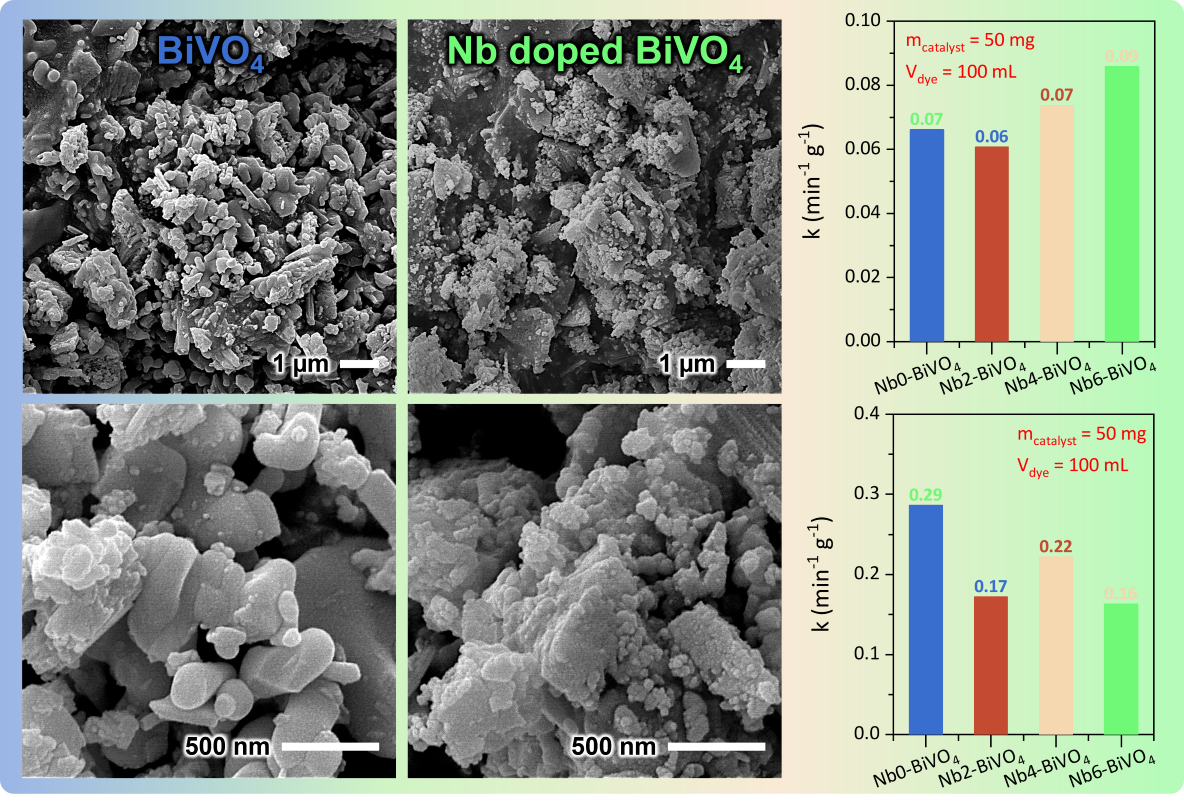
This study reports the synthesis and characterization of niobium-doped BiVO4 (NbX-BiVO4, X = 0, 2, 4, 6 mol%) photocatalysts via a hydrothermal method, aimed at enhancing the degradation of organic pollutants under UV irradiation. X-ray diffraction (XRD) analysis confirmed the preservation of the monoclinic BiVO4 structure in all samples, although minor secondary features were detected in doped compositions. Field emission scanning electron microscope (FESEM) imaging revealed progressively rougher, nanostructured surfaces with increasing Nb content, while UV-Vis and photoluminescence (PL) spectroscopy indicated modified band structures and reduced recombination rates. Photocatalytic performance was evaluated using ciprofloxacin (CIP) and methylene blue (MB) as model pollutants. For CIP, the highest activity was achieved by Nb6-BiVO4 (k value of 0.09 min‒1 g–1), attributable to enhanced charge separation and increased surface texture. In contrast, MB degradation favored the undoped BiVO4 (k value of 0.29 min‒1 g–1) due to stronger dye adsorption, despite the optical improvements in doped samples. The findings demonstrate that Nb doping improves BiVO4 photocatalytic activity through synergistic structural and electronic effects, with pollutant-specific responses highlighting the importance of matching catalyst design to target contaminant properties.
Keywords
References
- [1] M.N. Subramaniam, P.S. Goh, D. Kanakaraju, J.W. Lim, W.J. Lau, A.F. Ismail, Photocatalytic membranes: a new perspective for persistent organic pollutants removal, Environmental Science and Pollution Research 29 (2022) 12506–12530. https://doi.org/10.1007/s11356-021-14676-x.
- [2] T.E. Doll, F.H. Frimmel, Removal of selected persistent organic pollutants by heterogeneous photocatalysis in water, Catal Today 101 (2005) 195–202. https://doi.org/10.1016/j.cattod.2005.03.005.
- [3] B. Patial, A. Bansal, R. Gupta, S.K. Mittal, BiVO 4 -based heterojunction nanophotocatalysts for water splitting and organic pollutant degradation: a comprehensive review of photocatalytic innovation, Reviews in Inorganic Chemistry 44 (2024) 495–519. https://doi.org/10.1515/revic-2024-0009.
- [4] S. Lotfi, M. El Ouardi, H.A. Ahsaine, A. Assani, Recent progress on the synthesis, morphology and photocatalytic dye degradation of BiVO 4 photocatalysts: A review, Catalysis Reviews 66 (2024) 214–258. https://doi.org/10.1080/01614940.2022.2057044.
- [5] N.T. Khanh Huyen, T.-D. Pham, N.T. Dieu Cam, P. Van Quan, N. Van Noi, N.T. Hanh, M.H. Thanh Tung, V.-D. Dao, Fabrication of titanium doped BiVO4 as a novel visible light driven photocatalyst for degradation of residual tetracycline pollutant, Ceram Int 47 (2021) 34253–34259. https://doi.org/10.1016/j.ceramint.2021.08.335.
- [6] C. Regmi, Y.K. Kshetri, T.-H. Kim, R.P. Pandey, S.W. Lee, Visible-light-induced Fe-doped BiVO4 photocatalyst for contaminated water treatment, Molecular Catalysis 432 (2017) 220–231. https://doi.org/10.1016/j.mcat.2017.02.004.
- [7] C. Regmi, Y.K. Kshetri, R.P. Pandey, T.-H. Kim, G. Gyawali, S.W. Lee, Understanding the multifunctionality in Cu-doped BiVO4 semiconductor photocatalyst, Journal of Environmental Sciences 75 (2019) 84–97. https://doi.org/10.1016/j.jes.2018.03.005.
- [8] B. Guan, J. Chen, Z. Li, Z. Zhuang, Y. Chen, Z. Ma, J. Guo, C. Zhu, X. Hu, S. Zhao, H. Dang, L. Chen, K. Shu, Z. Guo, K. Shi, Y. Li, C. Yi, J. Hu, Z. Huang, Review on Synthesis, Modification, Morphology, and Combination of BiVO 4 -based Catalysts for Photochemistry: Status, Advances, and Perspectives, Energy & Fuels 38 (2024) 806–853. https://doi.org/10.1021/acs.energyfuels.3c03932.
- [9] J. Liu, B. Li, L. Kong, Q. Xiao, S. Huang, Surfactants-assisted morphological regulation of BiVO4 nanostructures for photocatalytic degradation of organic pollutants in wastewater, Journal of Physics and Chemistry of Solids 172 (2023) 111079. https://doi.org/10.1016/j.jpcs.2022.111079.
- [10] A. Zhang, Y. Liang, H. Zhang, Z. Geng, J. Zeng, Doping regulation in transition metal compounds for electrocatalysis, Chem Soc Rev 50 (2021) 9817–9844. https://doi.org/10.1039/D1CS00330E.
- [11] W. Yan, X. Liu, Niobium-Doped TiO 2 : Effect of an Interstitial Oxygen Atom on the Charge State of Niobium, Inorg Chem 58 (2019) 3090–3098. https://doi.org/10.1021/acs.inorgchem.8b03096.
- [12] E. Santos, A.C. Catto, A.F. Peterline, W. Avansi Jr, Transition metal (Nb and W) doped TiO2 nanostructures: The role of metal doping in their photocatalytic activity and ozone gas-sensing performance, Appl Surf Sci 579 (2022) 152146. https://doi.org/10.1016/j.apsusc.2021.152146.
- [13] B.N. Nunes, W. van den Bergh, F. Strauss, A. Kondrakov, J. Janek, T. Brezesinski, The role of niobium in layered oxide cathodes for conventional lithium-ion and solid-state batteries, Inorg Chem Front 10 (2023) 7126–7145. https://doi.org/10.1039/D3QI01857A.
- [14] H.P. Sarker, P.M. Rao, M.N. Huda, Niobium Doping in BiVO 4 : Interplay Between Effective Mass, Stability, and Pressure, ChemPhysChem 20 (2019) 773–784. https://doi.org/10.1002/cphc.201800792.
- [15] S.S. Kalanur, H. Seo, An experimental and density functional theory studies of Nb-doped BiVO4 photoanodes for enhanced solar water splitting, J Catal 410 (2022) 144–155. https://doi.org/10.1016/j.jcat.2022.04.019.
- [16] K. Ren, J. Zhou, Z. Wu, Q. Sun, L. Qi, Dual Heterojunctions and Nanobowl Morphology Engineered BiVO 4 Photoanodes for Enhanced Solar Water Splitting, Small 20 (2024). https://doi.org/10.1002/smll.202304835.
- [17] Q. Sun, L. Yang, F. Hu, C. Liang, H. Wang, J. Qi, Microstructural evolution and kinetics of monoclinic scheelite-type BiVO4-based materials with enhanced color performance, Ceram Int 51 (2025) 40414–40430. https://doi.org/10.1016/j.ceramint.2025.06.276.
- [18] C. Cheng, H. Tan, W. Zhu, L. Liu, K. Chen, J. Yan, The transition of tetragonal to monoclinic phase in BiVO4 coupled with peroxymonosulfate for photocatalytic degradation of tetracycline hydrochloride, Environ Res 267 (2025) 120631. https://doi.org/10.1016/j.envres.2024.120631.
- [19] S.S. Kalanur, Y.J. Lee, H. Seo, A versatile synthesis strategy and band insights of monoclinic clinobisvanite BiVO4 thin films for enhanced photoelectrochemical water splitting activity, Appl Surf Sci 562 (2021) 150078. https://doi.org/10.1016/j.apsusc.2021.150078.
- [20] Y. Zou, M. Lu, Z. Jiang, L. Xu, C. Liu, L. Zhang, Y. Chen, Hydrothermal synthesis of Zn-doped BiVO4 with mixed crystal phase for enhanced photocatalytic activity, Opt Mater (Amst) 119 (2021) 111398. https://doi.org/10.1016/j.optmat.2021.111398.
- [21] S. Saxena, A. Verma, N.K. Biswas, S.A. Khan, V.R. Satsangi, R. Shrivastav, S. Dass, Zr–W Co-doping in BiVO4 – Synergistic effect in photoelectrochemical water splitting, Mater Chem Phys 267 (2021) 124675. https://doi.org/10.1016/j.matchemphys.2021.124675.
- [22] N. Singh, U. Kumar, N. Jatav, I. Sinha, Photocatalytic Degradation of Crystal Violet on Cu, Zn Doped BiVO 4 Particles, Langmuir 40 (2024) 8450–8462. https://doi.org/10.1021/acs.langmuir.3c04039.
- [23] S. Tekin, Y. Tutel, A. Karatay, H.E. Unalan, A. Elmali, Defect assisted enhanced nonlinear optical performance and optical limiting of pure and doped BiVO4 powders and nanocomposite films, J Lumin 252 (2022) 119362. https://doi.org/10.1016/j.jlumin.2022.119362.
- [24] D. Channei, P. Thammaacheep, S. Kerdphon, P. Jannoey, W. Khanitchaidecha, A. Nakaruk, Domestic microwave-assisted synthesis of Pd doped-BiVO4 photocatalysts, Inorg Chem Commun 150 (2023) 110478. https://doi.org/10.1016/j.inoche.2023.110478.


- Received: October 2, 2025
- Accepted: November 26, 2025
- Published: December 1, 2025
Graphical Abstract