Abstract
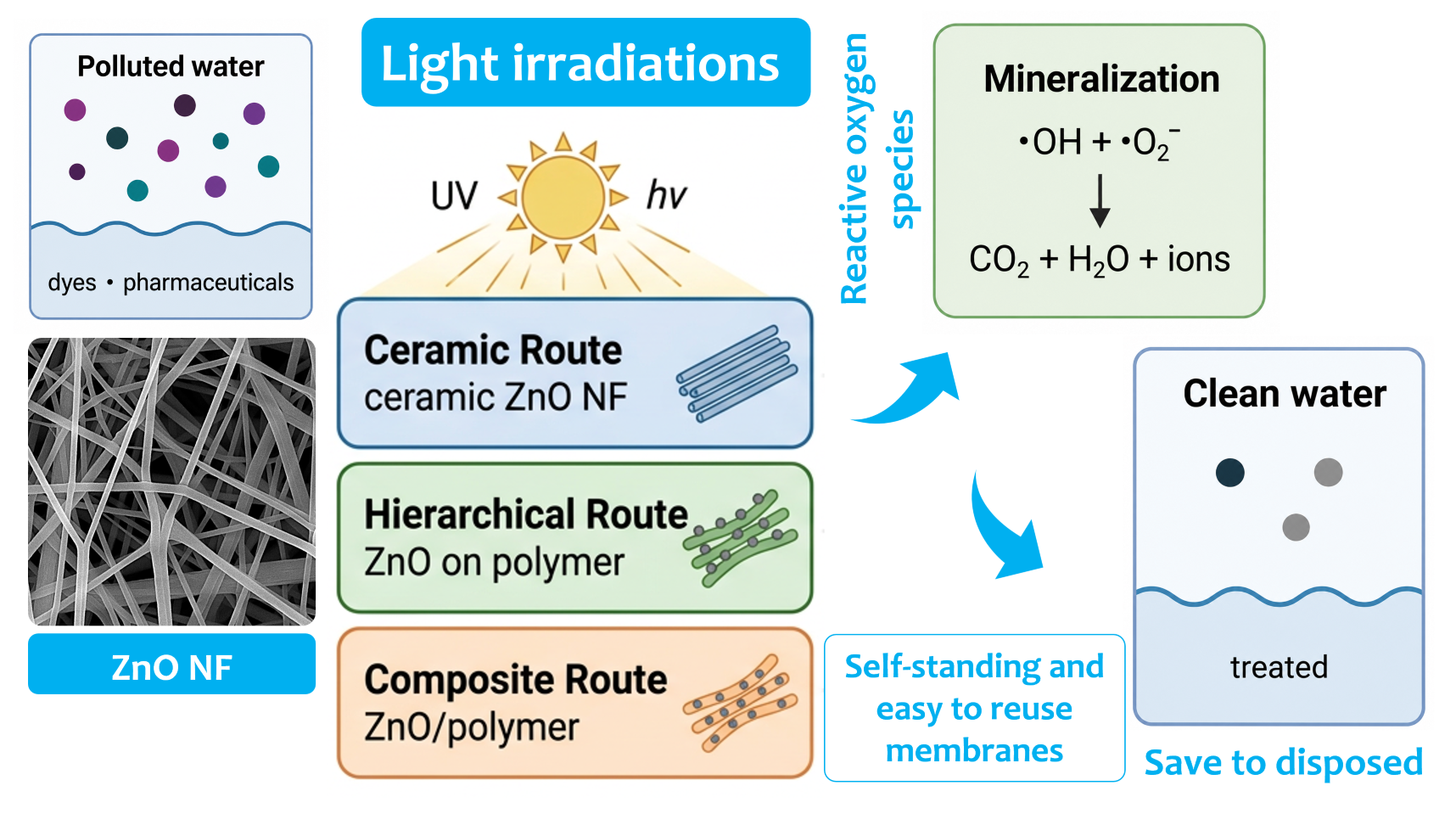
Electrospun ZnO nanofiber membranes are promising candidates for photocatalytic water treatment, offering directional charge transport, high surface-to-volume ratio, and self-standing membrane architectures that enable straightforward catalyst retrieval and reuse, a critical advantage over dispersed semiconductor nanoparticle systems where post-treatment recovery remains a major bottleneck. However, the fabrication route fundamentally determines membrane morphology, mechanical integrity, retrievability, and photocatalytic performance. This review classifies electrospinning-based fabrication into three routes: the Ceramic Membrane Route (precursor/polymer blending followed by calcination), the Hierarchical Membrane Route (secondary ZnO growth on electrospun polymer scaffolds), and the Composite Membrane Route (direct electrospinning of pre-synthesized ZnO/polymer dispersions). The Ceramic Membrane Route yields high-crystallinity membranes with up to 100% pollutant degradation but poor mechanical integrity that hinders membrane retrieval. The Composite Membrane Route provides single-step fabrication with the best demonstrated reusability (10 cycles at 97–99% retention), 200-fold lower zinc leaching, and excellent mechanical robustness for repeated retrieval and deployment, positioning it as one of the more operationally mature options for near-term deployment. The Hierarchical Membrane Route delivers the highest surface area, the fastest degradation kinetics, and uniquely combines photocatalysis with membrane filtration in a single device, making it a particularly promising long-term direction once its multi-step processing is streamlined and continuous-flow scale-up is realized. This comparative framework guides the selection of fabrication strategy based on membrane retrievability, performance, and development-stage requirements.Keywords
ZnO nanofiber membrane
electrospinning
photocatalytic membrane
water treatment
catalyst recovery
membrane reusability
References
- 1. Byrne Ciara, Subramanian Gokulakrishnan, Pillai Suresh C.. Recent advances in photocatalysis for environmental applications. Journal of Environmental Chemical Engineering. 2018;6:3531-3555. https://doi.org/10.1016/j.jece.2017.07.080
- 2. Koe Wei Song, Lee Jia Wei, Chong Woon Chan, Pang Yean Ling, Sim Lan Ching. An overview of photocatalytic degradation: photocatalysts, mechanisms, and development of photocatalytic membrane. Environmental Science and Pollution Research. 2020;27:2522-2565. https://doi.org/10.1007/s11356-019-07193-5
- 3. Lee Kian Mun, Lai Chin Wei, Ngai Koh Sing, Juan Joon Ching. Recent developments of zinc oxide based photocatalyst in water treatment technology: A review. Water Research. 2016;88:428-448. https://doi.org/10.1016/j.watres.2015.09.045
- 4. Ong Chi Boon, Ng Law Yong, Mohammad Abdul Wahab. A review of ZnO nanoparticles as solar photocatalysts: Synthesis, mechanisms and applications. Renewable and Sustainable Energy Reviews. 2018;81:536-551. https://doi.org/10.1016/j.rser.2017.08.020
- 5. Mozia Sylwia. Photocatalytic membrane reactors (PMRs) in water and wastewater treatment. A review. Separation and Purification Technology. 2010;73:71-91. https://doi.org/10.1016/j.seppur.2010.03.021
- 6. Leong Siewhui, Razmjou Amir, Wang Kun, Hapgood Karen, Zhang Xiwang, Wang Huanting. TiO2 based photocatalytic membranes: A review. Journal of Membrane Science. 2014;472:167-184. https://doi.org/10.1016/j.memsci.2014.08.016
- 7. Xue Jiajia, Wu Tong, Dai Yunqian, Xia Younan. Electrospinning and electrospun nanofibers: Methods, materials, and applications. Chemical Reviews. 2019;119:5298-5415. https://doi.org/10.1021/acs.chemrev.8b00593
- 8. Persano Luana, Camposeo Andrea, Tekmen Cagri, Pisignano Dario. Industrial upscaling of electrospinning and applications of polymer nanofibers: A review. Macromolecular Materials and Engineering. 2013;298:504-520. https://doi.org/10.1002/mame.201200290
- 9. Nasir Atikah Mohd, Awang Nuha, Jaafar Juhana, Ismail Ahmad Fauzi, Othman Mohd Hafiz Dzarfan, Rahman Mukhlis A., Aziz Farhana, Yajid Muhamad Azizi Mat. Recent progress on fabrication and application of electrospun nanofibrous photocatalytic membranes for wastewater treatment: A review. Journal of Water Process Engineering. 2021;40:101878. https://doi.org/10.1016/j.jwpe.2020.101878
- 10. Cordoba Alexander, Saldias Cesar, Urzúa Marcela, Montalti Marco, Guernelli Moreno, Focarete Maria Letizia, Leiva Angel. On the versatile role of electrospun polymer nanofibers as photocatalytic hybrid materials applied to contaminated water remediation: A brief review. Nanomaterials. 2022;12:756. https://doi.org/10.3390/nano12050756
- 11. Mapukata Sivuyisiwe, Shingange Katekani, Mokhena Teboho. Review of the recent advances on the fabrication, modification and application of electrospun TiO2 and ZnO nanofibers for the treatment of organic pollutants in wastewater. Frontiers in Chemical Engineering. 2023;5:1304128. https://doi.org/10.3389/fceng.2023.1304128
- 12. Serik Aigerim, Idrissov Nurlan, Baratov Aibol, Dikov Alexey, Kislitsin Sergey, Daulbayev Chingis, Kuspanov Zhengisbek. Recent progress in photocatalytic applications of electrospun nanofibers: A review. Molecules. 2024;29:4824. https://doi.org/10.3390/molecules29204824
- 13. Mhalshekar Krushika, Krishan Anurag, Gaydhane Mrunalini, Sontakke Sharad, Pawar Vivek. Advanced electrospun nanofibers for photocatalytic degradation: Sustainable solutions for wastewater remediation. ACS Omega. 2026;11:6954-6985. https://doi.org/10.1021/acsomega.5c10970
- 14. Sarkodie Benjamin, Amesimeku Joshua, Frimpong Charles, Howard Ebenezer Kofi, Feng Quan, Xu Zhenzhen. Photocatalytic degradation of dyes by novel electrospun nanofibers: A review. Chemosphere. 2023;313:137654. https://doi.org/10.1016/j.chemosphere.2022.137654
- 15. Panda Pravat Kumar, Sahoo Biswajit, Ramakrishna Seeram. Electrospun nanofibers for photocatalytic water treatment and hydrogen generation application: A review. International Journal of Hydrogen Energy. 2023;48:37193-37208. https://doi.org/10.1016/j.ijhydene.2023.06.151
- 16. Lu Na, Zhang Mingming, Jing Xueru, Zhang Pengfei, Zhu Yongan, Zhang Zhenyi. Electrospun semiconductor-based nano-heterostructures for photocatalytic energy conversion and environmental remediation: Opportunities and challenges. Energy and Environmental Materials. 2023;6:e12338. https://doi.org/10.1002/eem2.12338
- 17. Samadi Morasae, Zirak Mahdi, Naseri Amene, Khorashadizade Elham, Moshfegh Alireza Z.. Recent progress on doped ZnO nanostructures for visible-light photocatalysis. Thin Solid Films. 2016;605:2-19. https://doi.org/10.1016/j.tsf.2015.12.064
- 18. Rianjanu Aditya, Nurfitria Rima, Nurfani Eka, Aflaha Rizky, Triyana Kuwat, Taher Tarmizi, Andreani Agustina Sus, Gultom Noto Susanto, Widakdo Januar, Hapidin Dian Ahmad, Peiner Erwin, Wasisto Hutomo Suryo. Unlocking the full potential of zinc oxide/cerium oxide composite nanoparticles for removal of mixed pharmaceutical and dye pollutants in water. Advanced Materials Interfaces. 2026:70472. https://doi.org/10.1002/admi.70472
- 19. Pascariu Petronela, Homocianu Mihaela. ZnO-based ceramic nanofibers: Preparation, properties and applications. Ceramics International. 2022;48:18467-18501. https://doi.org/10.1016/j.ceramint.2022.03.128
- 20. Rianjanu Aditya. Recent advances in electrospun nanofiber membranes for dye filtration: A focused mini-review. Environmental Chemistry and Safety. 2025;1:9600018. https://doi.org/10.26599/ECS.2025.9600018
- 21. Baig Aliya, Siddique Mohsin, Panchal Suman. A review of visible-light-active zinc oxide photocatalysts for environmental application. Catalysts. 2025;15:100. https://doi.org/10.3390/catal15020100
- 22. Sanakousar F. M., Vidyasagar C. C., Jim'enez-P'erez V. M., Prakash K.. Recent progress on visible-light-driven metal and non-metal doped ZnO nanostructures for photocatalytic degradation of organic pollutants. Materials Science in Semiconductor Processing. 2022;140:106390. https://doi.org/10.1016/j.mssp.2021.106390
- 23. Zheng Andrew Lim Teik, Abdullah Che Azurahanim Che, Chung Eric Lim Teik, Andou Yoshito. Recent progress in visible light-doped ZnO photocatalyst for pollution control. International Journal of Environmental Science and Technology. 2023;20:5753-5772. https://doi.org/10.1007/s13762-022-04354-x
- 24. Mao Tianhao, Liu Mingyue, Lin Lina, Cheng Yuting, Fang Chunhua. A study on doping and compound of zinc oxide photocatalysts. Polymers. 2022;14:4484. https://doi.org/10.3390/polym14214484
- 25. Ahmad Iqbal, Bousbih Rim, Mahal Ahmed, Henaish Ahmed, Alharthi Sarah, Alharthi Najla S., Aldhafeeri Nawaf, Alanazi Maha M., Almisri Abdulaziz N., Alhomaidi Eman A., Alanazi Yasmeen M., Alanazi Mohammed M., Alanazi Abdullah M.. Recent progress in ZnO-based heterostructured photocatalysts: A review. Materials Science in Semiconductor Processing. 2024;180:108578. https://doi.org/10.1016/j.mssp.2024.108578
- 26. Dhiman Pankaj, Rana Garima, Kumar Amit, Sharma Gaurav, Vo Dai-Viet N., Naushad Mu.. ZnO-based heterostructures as photocatalysts for hydrogen generation and depollution: A review. Environmental Chemistry Letters. 2022;20:1047-1081. https://doi.org/10.1007/s10311-021-01361-1
- 27. Rasheed Hafiz Muhammad, Aroosh Komal, Meng Daimei, Ruan Xianguang, Akhter Mohsina, Cui Xiaoqiang. A review on modified ZnO to address environmental challenges through photocatalysis: Photodegradation of organic pollutants. Materials Today Energy. 2025;48:101774. https://doi.org/10.1016/j.mtener.2024.101774
- 28. Abdul Halim Othman M., Mustapha Nurul Hidayah, Mohd Fudzi Siti Nor, Azhar Roshazma, Zanal Nor Izzah Najwa, Nazua Nur Farhana, Nordin Ahmad Hafiz, Mohd Azami Mohd Sufri, Mohd Ishak Mohd Azlan, Wan Ismail Wan Iryani Najwa, Ahmad Zulkifli. A review on modified ZnO for the effective degradation of methylene blue and rhodamine B. Results in Surfaces and Interfaces. 2025;18:100408. https://doi.org/10.1016/j.rsurfi.2024.100408
- 29. Abdullah Fatin Hanani, Abu Bakar Noor Haida Hayati, Abu Bakar Mohamad. Current advancements on the fabrication, modification, and industrial application of zinc oxide as photocatalyst in the removal of organic and inorganic contaminants in aquatic systems. Journal of Hazardous Materials. 2022;424:127416. https://doi.org/10.1016/j.jhazmat.2021.127416
- 30. Abou Zeid Sara, Leprince-Wang Yamin. Advancements in ZnO-based photocatalysts for water treatment: A comprehensive review. Crystals. 2024;14:611. https://doi.org/10.3390/cryst14070611
- 31. Zhu Chuang, Wang Xin. Nanomaterial ZnO synthesis and its photocatalytic applications: A review. Nanomaterials. 2025;15:682. https://doi.org/10.3390/nano15090682
- 32. Kadhim Mustafa Jasim, Mahdi Mohammed A., Selman Ahmed M., Al-Ani Sabah K. J., Hassan Jamal J., Ahmed Naser M.. The most important parameters that affect the photocatalytic activity of ZnO nanostructures against organic dyes: A review. Iranian Journal of Catalysis. 2023;13:1-21. https://doi.org/10.30495/ijc.2023.1969439.1966
- 33. Ghamarpoor Reza, Fallah Atefeh, Jamshidi Masoud. A review of synthesis methods, modifications, and mechanisms of ZnO/TiO2-based photocatalysts for photodegradation of contaminants. ACS Omega. 2024;9:25457-25492. https://doi.org/10.1021/acsomega.3c08717
- 34. AlMohamadi Hamad, Awad Sherif A., Sharma Anjan Kumar, Fayzullaev Normurot, T'avara-Aponte Alfonso, Chiguala-Contreras Liz, Amari Abdelfattah, Rodriguez-Benites Carmen, Tahoon Mohamed A., Esmaeili Hossein. Photocatalytic activity of metal- and non-metal-anchored ZnO and TiO2 nanocatalysts for advanced photocatalysis: Comparative study. Catalysts. 2024;14:420. https://doi.org/10.3390/catal14070420
- 35. Abdul Mutalib Aishah Aqilah, Jaafar Nur Farhana. ZnO photocatalysts applications in abating the organic pollutant contamination: A mini review. Total Environment Research Themes. 2022;1–2:100013. https://doi.org/10.1016/j.totert.2022.100013
- 36. G"uell Frank, Gald'amez-Mart'inez Andr'es, Mart'inez-Alanis Paulina R., Catto Ariadne C., da Silva Luis F., Mastelaro Valmor R., Santana Guillermo, Dutt Ateet. ZnO-based nanomaterials approach for photocatalytic and sensing applications: Recent progress and trends. Materials Advances. 2023;4:3685-3707. https://doi.org/10.1039/D3MA00227F
- 37. Kazemi Hakki Hossein, Sillanp"a"a Mika. Comprehensive analysis of photocatalytic and photoreactor challenges in photocatalytic wastewater treatment: A case study with ZnO photocatalyst. Materials Science in Semiconductor Processing. 2024;181:108592. https://doi.org/10.1016/j.mssp.2024.108592
- 38. Kisslinger Ryan, Hua Weizhi, Shankar Karthik. Bulk and surface properties of zinc oxide. Physical Chemistry Chemical Physics. 2017;19:20104-20123. https://doi.org/10.1039/C7CP03434A
- 39. Zhang Qifeng, Dandeneau Christopher S., Zhou Xiaoyuan, Cao Guozhong. ZnO nanostructures for dye-sensitized solar cells. Advanced Materials. 2009;21:4087-4108. https://doi.org/10.1002/adma.200803827
- 40. Chen Ru, Tian Si-meng, Song Jing-hui, Zhao Guang-tai, Cao Xin-miao, Shi Qing-yu, Gong Weitao. Preparation of zinc oxide nanofibers and their photocatalytic degradation and antibacterial properties. Colloid and Polymer Science. 2025;303:2167-2177. https://doi.org/10.1007/s00396-025-05472-x
- 41. Flores-Garcia E., Hernandez-Landaverde M. A., Romero-Avila E., Ramirez-Bon R.. ZnO crystalline nanofibers with photocatalytic properties obtained from pork skin gelatin and zinc acetate fibers. Journal of Materials Science: Materials in Electronics. 2025;36:1662. https://doi.org/10.1007/s10854-025-15703-0
- 42. Pan Tiandi, Liu Yong, Li Zongjie, Fan Jie, Wang Liang, Liu Jian, Shou Wan. A Sm-doped Egeria-densa-like ZnO nanowires@PVDF nanofiber membrane for high-efficiency water clean. Science of the Total Environment. 2020;737:139818. https://doi.org/10.1016/j.scitotenv.2020.139818
- 43. Yan Hongsheng, Xiong Jie, Du Peijian, Wu Ermiao, Pan Tiandi, Li Ni. Construction of ZnO/PPy/PAN nanofiber membrane as heterojunction photocatalyst with enhanced photocatalytic activity. Fibers and Polymers. 2025;26:589-596. https://doi.org/10.1007/s12221-024-00839-3
- 44. Lu Wei, Gu Tongtong, Jing Xuedong, Zhu Yongan, Yu Linqun, Hou Shichao, Pang Tingting, Lu Na, Zhang Zhenyi. Ag nanoparticles-decorated p-type CuO/n-type ZnO heterojunction nanofibers with enhanced photocatalytic activities for dye degradation and disinfection. Journal of Alloys and Compounds. 2023;968:171864. https://doi.org/10.1016/j.jallcom.2023.171864
- 45. Han Jingbo, Qiu Wei, Gao Wei. Potential dissolution and photo-dissolution of ZnO thin films. Journal of Hazardous Materials. 2010;178:115-122. https://doi.org/10.1016/j.jhazmat.2010.01.050
- 46. Aflaha Rizky, Putri Linda Ardita, Farrel Aloysius, Anzinger Sebastian, Rianjanu Aditya, Yulianto Nursidik, Fueldner Marc, Roto Roto, Peiner Erwin, Wasisto Hutomo Suryo, Triyana Kuwat. Crafting high-temperature stable and hydrophobic nanofiber membranes for particulate matter filtration. Communications Materials. 2025;6:107. https://doi.org/10.1038/s43246-025-00799-y
- 47. Rianjanu Aditya, Roto Roto, Julian Trisna, Hidayat Shidiq Nur, Kusumaatmaja Ahmad, Suyono Eko Agus, Triyana Kuwat. Polyacrylonitrile nanofiber-based quartz crystal microbalance for sensitive detection of safrole. Sensors. 2018;18:1150. https://doi.org/10.3390/s18041150
- 48. Chotimah, Rianjanu Aditya, Winardianto Bimo, Munir Misbachul, Kartini Indriana, Triyana Kuwat. Electrical conductivity improvement of polyvinyl alcohol nanofiber by solvent vapour treatment. International Journal on Advanced Science, Engineering and Information Technology. 2016;6:675-681. https://doi.org/10.18517/ijaseit.6.5.1055
- 49. Aflaha Rizky, Putri Linda Ardita, Maharani Chlara Naren, Rianjanu Aditya, Roto Roto, Wasisto Hutomo Suryo, Triyana Kuwat. Tuning a superhydrophobic surface on an electrospun polyacrylonitrile nanofiber membrane by polysulfone blending. ACS Omega. 2024;9:29840-29847. https://doi.org/10.1021/acsomega.4c03554
- 50. Rianjanu Aditya, Kusumaatmaja Ahmad, Suyono Eko Agus, Triyana Kuwat. Solvent vapor treatment improves mechanical strength of electrospun polyvinyl alcohol nanofibers. Heliyon. 2018;4:e00592. https://doi.org/10.1016/j.heliyon.2018.e00592
- 51. Aflaha Rizky, Maharani Chlara Naren, Putri Linda Ardita, Prabowo Yuliyan Dwi, Rahman Iman, Taher Tarmizi, Rianjanu Aditya, Roto Roto, Wasisto Hutomo Suryo, Triyana Kuwat. A superhydrophobic and heat-resistant PAN/PSU/PTFE composite nanofiber membrane for high-efficiency {PM1.0} and {PM2.5} filtration. Materials Advances. 2024;5:9215-9226. https://doi.org/10.1039/d4ma00841c
- 52. Cao Yilin, Xu Lan. Hollow ZnO nanofibers for efficient photocatalytic degradation of methylene blue. Catalysts. 2025;15:1137. https://doi.org/10.3390/catal15121137
- 53. Yang Yaoyao, Zhou Shengwei, Cao Xianyang, Lv He, Liang Zhiyuan, Zhang Rui, Ye Fujia, Yu Dengguang. Coaxial electrospun porous core–shell nanofibrous membranes for photodegradation of organic dyes. Polymers. 2024;16:754. https://doi.org/10.3390/polym16060754
- 54. Kim Wan-Tae, Na Kyeong-Han, Park Dong-Cheol, Yang Wan-Hee, Choi Won-Youl. Photocatalytic methylene blue degradation of electrospun Ti–Zn complex oxide nanofibers. Nanomaterials. 2020;10:1311. https://doi.org/10.3390/nano10071311
- 55. Meng Qingming, Liu Wenna, Jiang Juan, Zhang Xinle. Fabrication of novel p-CuO/n-ZnO heterojunction nanofibers by electrospinning for enhanced photocatalytic performance in the denitrification of fuel oil. Ceramics International. 2021;47:19402-19413. https://doi.org/10.1016/j.ceramint.2021.03.277
- 56. Liu Liu, Liu Zhiwei, Yang Yixin, Geng Mingqian, Zou Yiming, Shahzad M. Babar, Dai Yuxiang, Qi Yang. Photocatalytic properties of Fe-doped ZnO electrospun nanofibers. Ceramics International. 2018;44:19998-20005. https://doi.org/10.1016/j.ceramint.2018.07.267
- 57. Naseri Amene, Samadi Morasae, Pourjavadi Ali, Ramakrishna Seeram, Moshfegh Alireza Z.. Enhanced photocatalytic activity of ZnO/g-C3N4 nanofibers constituting carbonaceous species under simulated sunlight for organic dye removal. Ceramics International. 2021;47:26185-26196. https://doi.org/10.1016/j.ceramint.2021.06.025
- 58. Singh Puneet, Mondal Kunal, Sharma Ashutosh. Reusable electrospun mesoporous ZnO nanofiber mats for photocatalytic degradation of polycyclic aromatic hydrocarbon dyes in wastewater. Journal of Colloid and Interface Science. 2013;394:208-215. https://doi.org/10.1016/j.jcis.2012.12.006
- 59. Pantò Fabiola, Dahrouch Zainab, Saha Abhirup, Patan`e Salvatore, Santangelo Saveria, Triolo Claudia. Photocatalytic degradation of methylene blue dye by porous zinc oxide nanofibers prepared via electrospinning: When defects become merits. Applied Surface Science. 2021;557:149830. https://doi.org/10.1016/j.apsusc.2021.149830
- 60. Chen Mingyi, Liu Peng, He Ji-Huan, Wang Hsing-Lin, Zhang Haonan, Wang Xin, Chen Rouxi. Nanofiber template-induced preparation of ZnO nanocrystal and its application in photocatalysis. Scientific Reports. 2021;11:21196. https://doi.org/10.1038/s41598-021-00303-9
- 61. Asghari Sarabi Ghazale, Samadi Morasae, Bagheri Habib, Kibria Md. Golam, Moshfegh Alireza Z.. Floating Ag-ZnO@PAN nanofiber mats with photocatalytic, piezoelectric, and plasmonic functions for wastewater treatment. Research on Chemical Intermediates. 2025;51:6487-6514. https://doi.org/10.1007/s11164-025-05759-2
- 62. Araújo Evando S., da Costa Bruna P., Oliveira Raquel A. P., Libardi Juliano, Faia Pedro M., de Oliveira Helinando P.. TiO2/ZnO hierarchical heteronanostructures: Synthesis, characterization and application as photocatalysts. Journal of Environmental Chemical Engineering. 2016;4:2820-2829. https://doi.org/10.1016/j.jece.2016.05.021
- 63. Feng Lian, Zhang Penghao, Li Yuan, Ye Fangxin, Ma Yanze, He Gongtian, Lv Mingyu, Zhang Tian. Controllable fabrication of Ag/ZnO/g-C3N4 nanofiber heterojunctions for enhanced photocatalytic water disinfection. Frontiers of Materials Science. 2025;19:250720. https://doi.org/10.1007/s11706-025-0720-5
- 64. Tissera Nadeeka D., Wijesena Ruchira N., Sandaruwan Chanaka S., de Silva Rohini M., de Alwis Ajith, de Silva K. M. Nalin. Photocatalytic activity of ZnO nanoparticle encapsulated poly(acrylonitrile) nanofibers. Materials Chemistry and Physics. 2018;204:195-206. https://doi.org/10.1016/j.matchemphys.2017.10.035
- 65. Yar Adem, Haspulat Bircan, Ustun Tugay, Eskizeybek Volkan, Avci Ahmet, Kamis Handan, Achour Slimane. Electrospun TiO2/ZnO/PAN hybrid nanofiber membranes with efficient photocatalytic activity. RSC Advances. 2017;7:29806-29814. https://doi.org/10.1039/c7ra03699j
- 66. Parangusan Hemalatha, Bhadra Jolly, Ahmad Zubair, Al-Maadeed Ali S. M. A., Al-Mohannadi Abdulaziz M. A. A., Al-Thani Noora. Electrospun PVDF/ZnO based composite fibers for oil absorption and photocatalytic degradation of organic dyes from waste water. Fibers and Polymers. 2022;23:1217-1224. https://doi.org/10.1007/s12221-022-4542-0
- 67. Pascariu Petronela, Cojocaru Corneliu, Samoila Petrisor, Olaru Niculae, Bele Adrian, Airinei Anton. Novel electrospun membranes based on PVDF fibers embedding lanthanide doped ZnO for adsorption and photocatalytic degradation of dye organic pollutants. Materials Research Bulletin. 2021;141:111376. https://doi.org/10.1016/j.materresbull.2021.111376
- 68. Herath Hasitha, Pasindu Viduranga, Yapa Piumika, Dabare Sanduni, Munaweera Imalka, Weerasekera Manjula M., Samarakoon Upeka. Fabrication and characterization of Cu-ZnO-cellulose acetate electrospun nanocomposite membranes for dual-function photocatalytic degradation and microbial inhibition. Materials Advances. 2025;6:8092-8113. https://doi.org/10.1039/d5ma00890e
- 69. Pasindu Viraj, Yapa Piumika, Dabare Sanduni, Munaweera Imalka, Etampawala Thusitha, Weerasekera Manjula M., Attygalle Dinesh, Amarasinghe Shantha. Harnessing the power of visible light with GO-Ni-ZnO nanohybrid electrospun polymeric membranes for improved photocatalysis: a focused approach to fabrication, characterization, and applications. Emergent Materials. 2025;8:6817-6842. https://doi.org/10.1007/s42247-025-01188-4
- 70. Jena Sandeep Kumar, Sadasivam Rajkumar, Packirisamy Gopinath, Saravanan Pichiah. Nanoremediation: Sunlight mediated dye degradation using electrospun PAN/CuO-ZnO nanofibrous composites. Environmental Pollution. 2021;280:116964. https://doi.org/10.1016/j.envpol.2021.116964
- 71. Alias Nur Hanis, Jaafar Juhana, Samitsu Sadaki, Matsuura Takeshi, Ismail Ahmad Fauzi, Othman Mohd Hafiz Dzarfan, Rahman Mukhlis A., Othman Nor Haniza, Paiman Norhaniza, Yusof Norhaniza, Aziz Farhana. Photocatalytic nanofiber-coated alumina hollow fiber membranes for highly efficient oilfield produced water treatment. Chemical Engineering Journal. 2019;360:1437-1446. https://doi.org/10.1016/j.cej.2018.10.217
- 72. Phan Duy-Nam, Khan Muhammad Qamar, Nguyen Nien-Tzu, Phan Thanh-Truc, Ullah Amin, Khatri Muzamil, Kien Nguyen Ngoc, Kim Ick-Soo. A review on the fabrication of several carbohydrate polymers into nanofibrous structures using electrospinning for removal of metal ions and dyes. Carbohydrate Polymers. 2021;252:117175. https://doi.org/10.1016/j.carbpol.2020.117175


Cite this:
Greensusmater.
2026, 3, 1, 03
Publication History
- Received: April 10, 2026
- Accepted: May 5, 2026
- Published: May 25, 2026
DOI: 10.62755/gsm.2026.03
Copyright © 2026 | The Authors. This publication is licensed under
CC-BY 4.0.
Published by Green and Sustainable Materials Society.
Article Views
323
Downloads
0
Citations
Graphical Abstract
Cite
ACM
[1]
Rianjanu, A. et al. 2026. Electrospun ZnO Nanofiber Membranes for Photocatalytic Water Treatment: A Comparative Review of Fabrication Strategies. Greensusmater. 3, 1 (May 2026), 03. DOI:https://doi.org/10.62755/gsm.2026.03.
ACS
(1)
Rianjanu, A.; Nurfani, E.; Taher, T. Electrospun ZnO Nanofiber Membranes for Photocatalytic Water Treatment: A Comparative Review of Fabrication Strategies. greensusmater 2026, 3, 03.
APA
Rianjanu, A., Nurfani, E., & Taher, T. (2026). Electrospun ZnO Nanofiber Membranes for Photocatalytic Water Treatment: A Comparative Review of Fabrication Strategies. Greensusmater, 3(1), 03. https://doi.org/10.62755/gsm.2026.03
ABNT
RIANJANU, Aditya; NURFANI, Eka; TAHER, Tarmizi. Electrospun ZnO Nanofiber Membranes for Photocatalytic Water Treatment: A Comparative Review of Fabrication Strategies. Greensusmater, [S. l.], v. 3, n. 1, p. 03, 2026. DOI: 10.62755/gsm.2026.03. Disponível em: https://greensusmater.com/gsm/article/view/64. Acesso em: 22 sep. 2026.
Chicago
Rianjanu, Aditya, Eka Nurfani, and Tarmizi Taher. 2026. “Electrospun ZnO Nanofiber Membranes for Photocatalytic Water Treatment: A Comparative Review of Fabrication Strategies”. Greensusmater 3 (1):03. https://doi.org/10.62755/gsm.2026.03.
Harvard
Rianjanu, A., Nurfani, E. and Taher, T. (2026) “Electrospun ZnO Nanofiber Membranes for Photocatalytic Water Treatment: A Comparative Review of Fabrication Strategies”, Greensusmater, 3(1), p. 03. doi: 10.62755/gsm.2026.03.
IEEE
[1]
A. Rianjanu, E. Nurfani, and T. Taher, “Electrospun ZnO Nanofiber Membranes for Photocatalytic Water Treatment: A Comparative Review of Fabrication Strategies”, greensusmater, vol. 3, no. 1, p. 03, May 2026.
MLA
Rianjanu, Aditya, et al. “Electrospun ZnO Nanofiber Membranes for Photocatalytic Water Treatment: A Comparative Review of Fabrication Strategies”. Greensusmater, vol. 3, no. 1, May 2026, p. 03, doi:10.62755/gsm.2026.03.
Turabian
Rianjanu, Aditya, Eka Nurfani, and Tarmizi Taher. “Electrospun ZnO Nanofiber Membranes for Photocatalytic Water Treatment: A Comparative Review of Fabrication Strategies”. Greensusmater 3, no. 1 (May 25, 2026): 03. Accessed September 22, 2026. https://greensusmater.com/gsm/article/view/64.
Vancouver
1.
Rianjanu A, Nurfani E, Taher T. Electrospun ZnO Nanofiber Membranes for Photocatalytic Water Treatment: A Comparative Review of Fabrication Strategies. greensusmater [Internet]. 2026 May 25 [cited 2026 Sep. 22];3(1):03. Available from: https://greensusmater.com/gsm/article/view/64