Editorial Process
Editorial Process
Overview
GSMS Publications is committed to maintaining the highest standards of scholarly publishing through a rigorous, transparent, and fair editorial process. All submitted manuscripts undergo thorough evaluation — from initial screening to peer review — before a final editorial decision is made.
Our journals use a single-blind peer review model, where the identities of reviewers are kept confidential from the authors, but reviewers have access to the authors' identities. This approach ensures accountability in authorship while protecting reviewer independence, allowing manuscripts to be evaluated on their scientific merit, originality, and relevance.
Process Overview
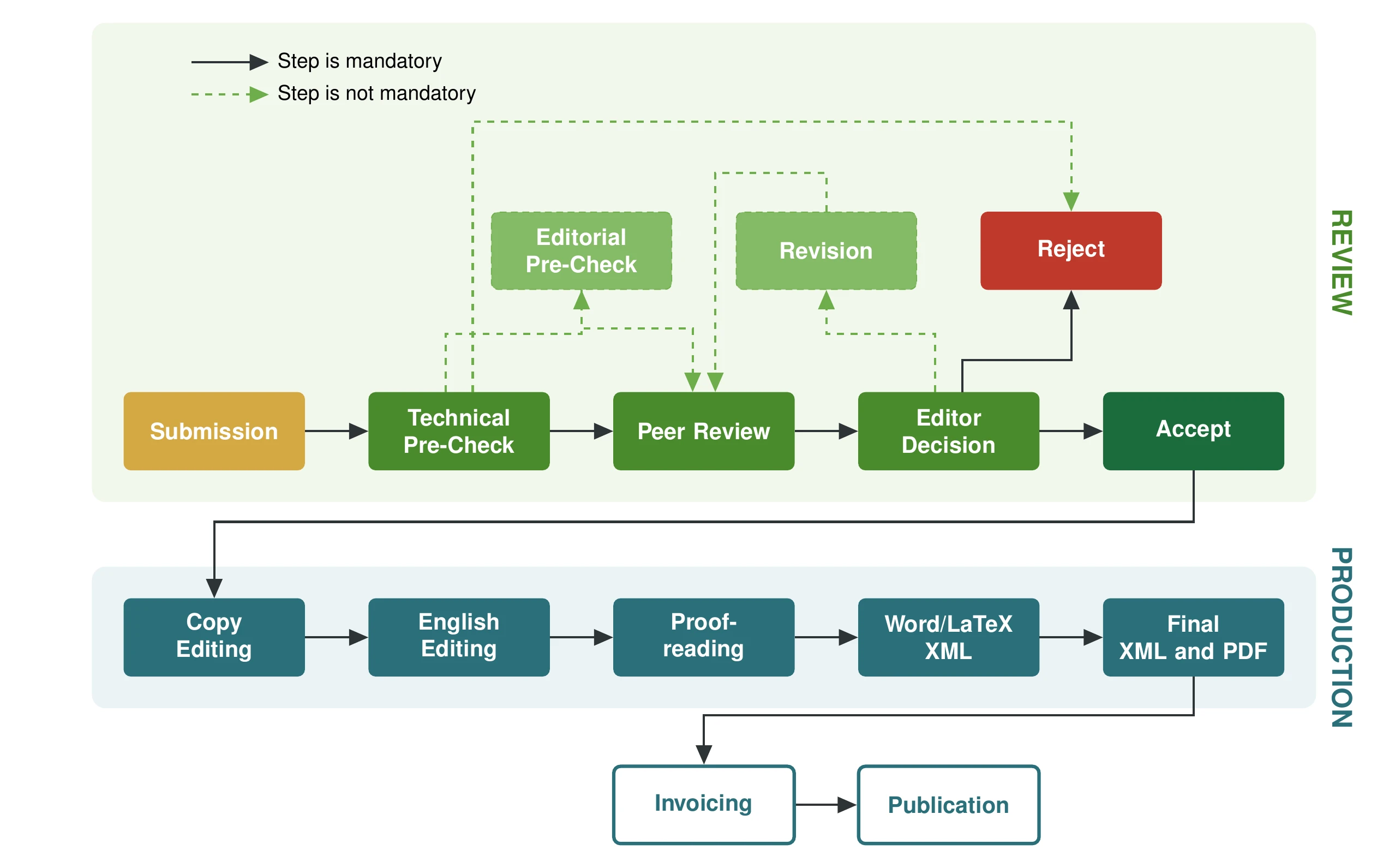
Typical timeline: 6–10 weeks from submission to first decision
1. Submission
How to Submit
Authors submit their manuscripts through the Open Journal Systems (OJS) platform. During submission, authors are required to:
- Register or log in to the journal's website
- Confirm compliance with submission requirements and the COPE guidelines
- Upload the manuscript file (formatted according to the journal's Author Guidelines)
- Provide metadata: title, abstract, keywords, author details, and ORCID iDs
- Include any supplementary files (datasets, figures, appendices)
- Submit a cover letter (recommended)
Authors may suggest preferred reviewers and indicate any reviewers they wish to exclude due to competing interests. The editorial team considers these suggestions but is not obligated to follow them.
2. Pre-Screening
Technical Check
Upon submission, the editorial office performs an initial technical check within 3–5 working days to verify:
- Formatting compliance — manuscript structure, reference style, and figure quality meet journal guidelines
- Completeness — all required sections, declarations, and metadata are present
- Plagiarism screening — the manuscript is checked using plagiarism detection software to ensure originality
- Scope — the topic falls within the journal's aims and scope
- Language quality — the manuscript is written in clear, readable English
Manuscripts that do not meet technical requirements may be returned to the author for correction or rejected outright (desk rejection). Authors whose manuscripts are returned are encouraged to revise and resubmit.
Editorial Pre-Check
Manuscripts that pass the technical check may be assigned to a Section Editor or Handling Editor for an additional evaluation of whether the manuscript:
- Presents sufficient novelty and scientific contribution
- Is methodologically sound at a preliminary level
- Warrants sending to external peer reviewers
The editor may reject the manuscript at this stage if it clearly falls outside scope, lacks originality, or has fundamental methodological issues.
3. Peer Review
Single-Blind Review
GSMS Publications uses a single-blind peer review process for all journals. This means:
- Authors do not know the identity of the reviewers
- Reviewers know the identity and affiliation of the authors
This model allows reviewers to assess the work in full context — including the authors' expertise and institutional resources — while maintaining reviewer anonymity to ensure honest and independent evaluation.
Reviewer Selection
The handling editor selects a minimum of two independent reviewers with relevant expertise. Reviewers are selected based on:
- Subject expertise and publication record
- Absence of competing interests with the authors
- Availability and past review quality
Reviewer Evaluation
Reviewers are asked to evaluate the manuscript on the following criteria:
- Originality — Does the work present new findings or insights?
- Scientific rigor — Are the methods appropriate and the analysis sound?
- Significance — Does the work contribute meaningfully to the field?
- Clarity — Is the manuscript well-written, well-organized, and clearly presented?
- Data and reproducibility — Are data, methods, and materials sufficiently described for reproducibility?
- References — Is the relevant literature adequately cited?
- Ethical compliance — Does the study meet ethical standards where applicable?
Reviewers provide a recommendation (accept, minor revision, major revision, or reject) along with detailed comments for the authors and confidential remarks for the editor.
Review Timeline
Reviewers are given 14–21 days to complete their review. If a reviewer is unable to respond within this period, the editor may send reminders or invite alternative reviewers to avoid delays.
4. Editorial Decision
Decision Types
After receiving peer review reports, the handling editor makes one of the following decisions:
| Decision | Description |
|---|---|
| Accept | The manuscript is accepted for publication as submitted or with only minor editorial corrections. |
| Minor Revision | The manuscript requires small changes (clarifications, minor additions). Revised version is typically reviewed by the editor only. |
| Major Revision | Significant changes are needed (additional experiments, reanalysis, restructuring). The revised manuscript is usually sent back to the original reviewers. |
| Reject | The manuscript does not meet the journal's standards and cannot be improved sufficiently through revision. |
Revision Process
Authors who receive a revision decision are expected to:
- Submit the revised manuscript within 14 days (minor revision) or 30 days (major revision)
- Provide a point-by-point response to all reviewer and editor comments
- Clearly highlight all changes made in the revised manuscript
If authors need additional time, they may request an extension by contacting the editorial office. Failure to submit a revision within the deadline may result in the manuscript being treated as a new submission.
Appeals
Authors who disagree with a rejection decision may submit a formal appeal to the Editor-in-Chief. Appeals must include:
- A detailed, point-by-point rebuttal addressing each reviewer's concern
- New evidence or data supporting the manuscript's validity, if applicable
The Editor-in-Chief will review the appeal and may seek additional opinions. The decision on the appeal is final.
5. Production
After Acceptance
Once a manuscript is accepted, it enters the production phase, which includes:
- Copy editing — grammar, spelling, punctuation, and style consistency are corrected
- Language editing — clarity and readability are improved where needed
- Layout and typesetting — the manuscript is formatted into the journal's publication template (PDF and HTML)
- Proofreading — authors receive galley proofs and have 5 working days to review and approve or request corrections
- Metadata preparation — DOI registration via Crossref, ORCID linking, and indexing metadata
Authors are expected to respond promptly during the proofing stage. Only corrections to typographical errors and factual mistakes are accepted at this point — no significant content changes.
6. Publication
Online Publication
Accepted articles are published online as soon as the production process is complete. Each article receives:
- A unique DOI (Digital Object Identifier) registered with Crossref
- Full-text availability in PDF and HTML formats
- Immediate open access under the CC-BY 4.0 license
- Indexing in Google Scholar, Dimensions, and other academic databases
Articles are assigned to an issue and volume. Published articles are permanent and cannot be removed except in cases of serious ethical violations, in which case a formal retraction notice will be issued following COPE retraction guidelines.
Publication Ethics
Ethical Standards
GSMS Publications follows the guidelines and best practices set by the Committee on Publication Ethics (COPE). We expect all parties — authors, reviewers, and editors — to adhere to the highest ethical standards.
For Authors
- All submitted work must be original and not previously published or under consideration elsewhere
- All contributing authors must be listed, and all listed authors must have made a substantial contribution
- Authors must disclose all funding sources and competing interests
- Any use of AI-assisted tools in the research or writing process must be disclosed
- Proper attribution and citation of all referenced work is required
- Data fabrication, falsification, and plagiarism are strictly prohibited
For Reviewers
- Reviews must be conducted objectively and constructively
- Reviewers must declare any competing interests and recuse themselves if necessary
- Manuscript content must be treated as confidential material
- Reviewers must not use unpublished data or ideas from manuscripts they review
For Editors
- Editorial decisions are based solely on scientific merit, not the authors' identity, affiliation, gender, or nationality
- Editors must manage competing interests transparently and recuse themselves when appropriate
- Editors ensure the confidentiality of the review process
Plagiarism & Misconduct
All manuscripts are screened for plagiarism using detection software. If misconduct is suspected or confirmed at any stage — before or after publication — GSMS Publications will follow COPE flowcharts to investigate and take appropriate action, which may include:
- Rejection of the manuscript
- Retraction of the published article
- Notification to the author's institution
- A ban on future submissions
Frequently Asked Questions
How long does the review process take?
The typical time from submission to first decision is 6–10 weeks. This includes pre-screening (3–5 days), peer review (14–21 days), and editorial decision. Actual timelines may vary depending on reviewer availability and the complexity of the manuscript.
Can I track my submission status?
Yes. Authors can log in to the OJS platform at any time to check the current status of their manuscript.
What if reviewers disagree?
If reviewers provide conflicting recommendations, the editor may invite an additional reviewer or make a decision based on the overall quality and strength of the reviews.
Can I suggest or exclude reviewers?
Yes. Authors may suggest up to three preferred reviewers and exclude up to two. The editorial team considers these suggestions but makes the final selection independently.
I have more questions
Please contact us at publications@greensus.org — we are happy to assist.