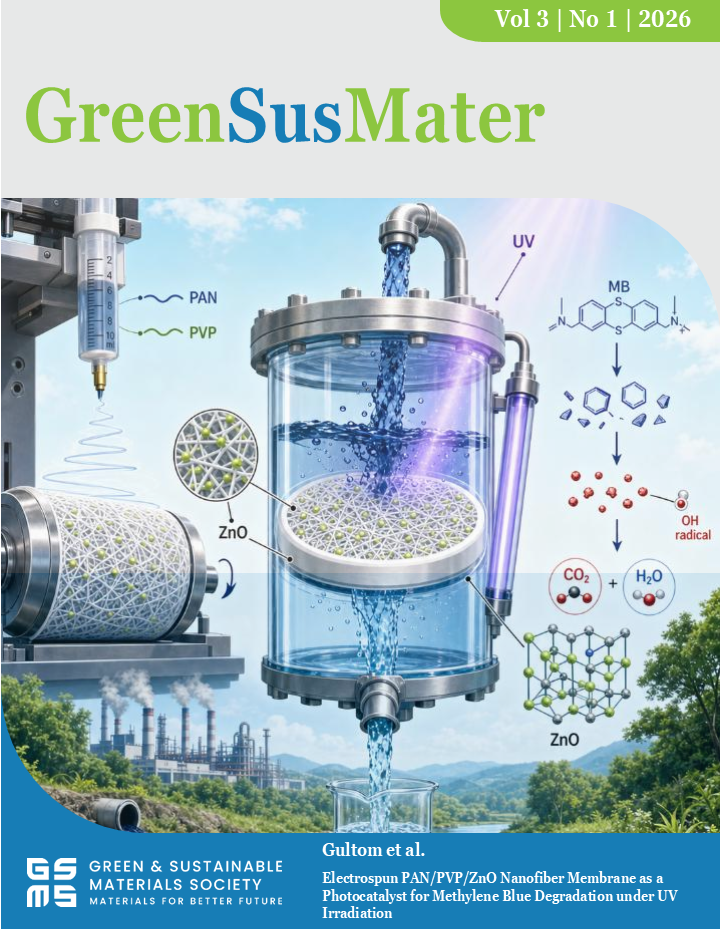
Electrospun PAN/PVP/ZnO Nanofiber Membrane as a Photocatalyst for Methylene Blue Degradation under UV Irradiation
- Aditya Rianjanu*

Abstract
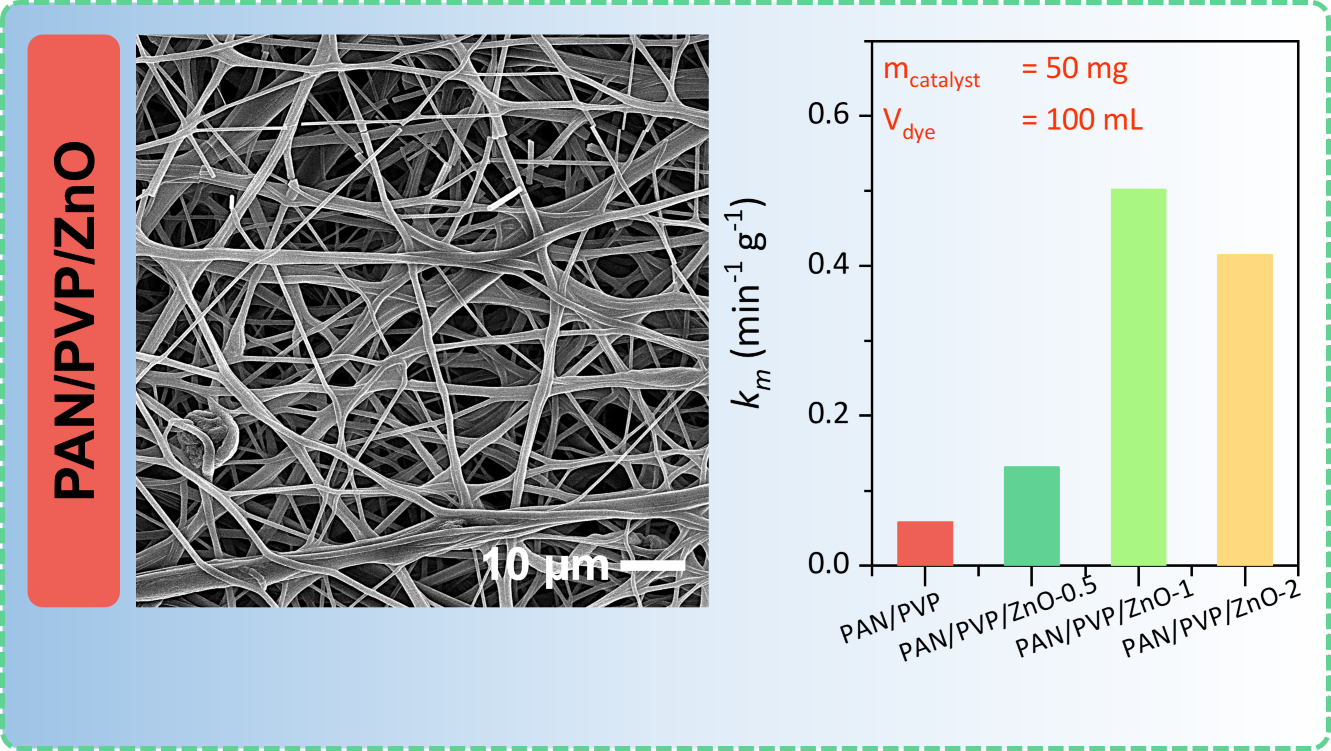
Textile dye pollution remains a critical environmental concern, necessitating the development of efficient and recoverable photocatalysts for wastewater remediation. In this study, polyacrylonitrile/polyvinylpyrrolidone/zinc oxide (PAN/PVP/ZnO) nanofiber membranes were fabricated via electrospinning with varying ZnO loadings (0, 0.5, 1, and 2 mmol) and evaluated for the photocatalytic degradation of methylene blue (MB) under ultraviolet (UV) irradiation. Scanning electron microscopy (SEM) revealed continuous, bead-free nanofibers with mean diameters of 355–552 nm, and energy dispersive X-ray spectroscopy (EDS) confirmed systematic Zn incorporation up to 34.52 wt%. A comparative study demonstrated that heat treatment at 450 °C was essential for converting the Zn(NO<sub>3</sub>)<sub>2</sub> precursor into the photocatalytically active ZnO phase. X-ray diffraction (XRD) and Fourier-transform infrared spectroscopy (FTIR) confirmed the retention of the polymer matrix integrity. Among the tested formulations, PAN/PVP/ZnO-1 (1 mmol) exhibited the highest photocatalytic performance, achieving approximately 95% MB degradation within 180 min, with a pseudo-first-order rate constant of k = 0.0251 min<sup>−1</sup> (R<sup>2</sup> = 0.9926), approximately 9 times faster than the neat PAN/PVP membrane. Higher ZnO loading (2 mmol) resulted in reduced photocatalytic performance. These findings indicate that 1 mmol ZnO is the optimal loading for PAN/PVP nanofiber photocatalysts, offering a promising recoverable membrane system for photocatalytic dye removal from wastewater.Keywords
electrospinning
PAN/PVP/ZnO nanofiber
Photocatalysis
methylene blue degradation
wastewater treatment
References
- 1. Aragaw TA. A review of dye biodegradation in textile wastewater, challenges due to wastewater characteristics, and the potential of alkaliphiles. Journal of Hazardous Materials Advances. 2024;16:100493. https://doi.org/10.1016/j.hazadv.2024.100493
- 2. Al-Tohamy R, Ali SS, Li F, Okasha KM, Mahmoud YA-G, Elsamahy T, Jiao H, Fu Y, Sun J. A critical review on the treatment of dye-containing wastewater: Ecotoxicological and health concerns of textile dyes and possible remediation approaches for environmental safety. Ecotoxicol. Environ. Saf.. 2022;231:113160. https://doi.org/10.1016/j.ecoenv.2021.113160
- 3. Oladoye PO, Ajiboye TO, Omotola EO, Oyewola OJ. Methylene blue dye: Toxicity and potential elimination technology from wastewater. Results in Engineering. 2022;16:100678. https://doi.org/10.1016/j.rineng.2022.100678
- 4. Ávila FG, Cabrera-Sumba J, Valdez-Pilataxi S, Villalta-Chungata J, Valdiviezo-Gonzales L, Alegria-Arnedo C. Removal of heavy metals in industrial wastewater using adsorption technology: Efficiency and influencing factors. Clean. Eng. Technol.. 2025;24:100879. https://doi.org/10.1016/j.clet.2025.100879
- 5. Eniola JO, Kumar R, Barakat MA, Rashid J. A review on conventional and advanced hybrid technologies for pharmaceutical wastewater treatment. J. Clean. Prod.. 2022;356:131826. https://doi.org/10.1016/j.jclepro.2022.131826
- 6. Khan MD, Singh A, Khan MZ, Tabraiz S, Sheikh J. Current perspectives, recent advancements, and efficiencies of various dye-containing wastewater treatment technologies. Journal of Water Process Engineering. 2023;53:103579. https://doi.org/10.1016/j.jwpe.2023.103579
- 7. Hong J, Cho K-H, Presser V, Su X. Recent advances in wastewater treatment using semiconductor photocatalysts. Curr. Opin. Green Sustain. Chem.. 2022;36:100644. https://doi.org/10.1016/j.cogsc.2022.100644
- 8. Iqbal M Ahtasham, Akram S, khalid S, Lal B, Hassan SU, Ashraf R, Kezembayeva G, Mushtaq M, Chinibayeva N, Hosseini-Bandegharaei A. Advanced photocatalysis as a viable and sustainable wastewater treatment process: A comprehensive review. Environ. Res.. 2024;253:118947. https://doi.org/10.1016/j.envres.2024.118947
- 9. Ray SK, Cho J, Hur J. A critical review on strategies for improving efficiency of BaTiO3-based photocatalysts for wastewater treatment. J. Environ. Manage.. 2021;290:112679. https://doi.org/10.1016/j.jenvman.2021.112679
- 10. Kanwal F, Javed T, Hussain F, Wasim M, Batool M. Enhanced dye photodegradation through ZnO and ZnO-based photocatalysts doped with selective transition metals: a review. Environmental Technology Reviews. 2024;13:754-793. https://doi.org/10.1080/21622515.2024.2426725
- 11. Manikanika, Chopra L, Kumar R. Combustion-synthesized ZnO-CeO2 heterojunctions for advanced photocatalytic dye degradation. Inorg. Chem. Commun.. 2024;160:111896. https://doi.org/10.1016/j.inoche.2023.111896
- 12. Das M, Ghatak A, Ray P Guha, Stachewicz U. Advancements in ZnO-based photocatalysts for effective rhodamine dye removal from water. Sustainable Materials and Technologies. 2024;42:e01138. https://doi.org/10.1016/j.susmat.2024.e01138
- 13. Venkatesh G, Palanisamy G, Lee J, Manimaran K, Abu-Yousef I, Kanan S. Synergistic effect of dual Z-scheme ZnO/g-C3N4/V2O5 heterogeneous nanocomposite for photocatalytic decontamination of mixed dye and pharmaceutical drug under visible light irradiation. J. Alloys Compd.. 2025;1010:178186. https://doi.org/10.1016/j.jallcom.2024.178186
- 14. Meng F, Liu Y, Wang J, Tan X, Sun H, Liu S, Wang S. Temperature dependent photocatalysis of g-C3N4, TiO2 and ZnO: Differences in photoactive mechanism. J. Colloid Interface Sci.. 2018;532:321-330. https://doi.org/10.1016/j.jcis.2018.07.131
- 15. Li N, Wang W, Zhu L, Cui W, Chen X, Zhang B, Zhang Z. A novel electro-cleanable PAN-ZnO nanofiber membrane with superior water flux and electrocatalytic properties for organic pollutant degradation. Chemical Engineering Journal. 2021;421:127857. https://doi.org/10.1016/j.cej.2020.127857
- 16. Mohammed MI, Khafagy RM, Hussien MSA, Sakr GB, Ibrahim MA, Yahia IS, Zahran HY. Enhancing the structural, optical, electrical, properties and photocatalytic applications of ZnO/PMMA nanocomposite membranes: towards multifunctional membranes. Journal of Materials Science: Materials in Electronics. 2022;33:1977-2002. https://doi.org/10.1007/s10854-021-07402-3
- 17. Li Y, Wang Y, Song J, Zheng K, Zhang H, Li J. A recyclable self-supporting flexible ZIF-8@aminated PAN-PVP material for highly selective phosphate removal from wastewater. Colloids Surf. A Physicochem. Eng. Asp.. 2025;707:135958. https://doi.org/10.1016/j.colsurfa.2024.135958
- 18. Selvam S, Sundrarajan M. Functionalization of cotton fabric with PVP/ZnO nanoparticles for improved reactive dyeability and antibacterial activity. Carbohydr. Polym.. 2012;87:1419-1424. https://doi.org/10.1016/j.carbpol.2011.09.025
- 19. Suo R, Xie L, Liao J, Chen J, Lu C-Z. Enhanced Charge Separation in a PAN/ZnO Nanocomposite for Promoted Photocatalytic Hydrogen Evolution. ACS Appl. Energy Mater.. 2024;7:5668-5678. https://doi.org/10.1021/acsaem.4c00521
- 20. Hartati S, Zulfi A, Maulida PYD, Yudhowijoyo A, Dioktyanto M, Saputro KE, Noviyanto A, Rochman NT. Synthesis of Electrospun PAN/TiO2/Ag Nanofibers Membrane As Potential Air Filtration Media with Photocatalytic Activity. ACS Omega. 2022;7:10516-10525. https://doi.org/10.1021/acsomega.2c00015
- 21. Wei T, Li W, Zhang J, Xie X. Synthesis of Tb2O3/ZnO composite nanofibers via electrospinning as chemiresistive gas sensor for detecting NO gas. J. Alloys Compd.. 2023;947:169651. https://doi.org/10.1016/j.jallcom.2023.169651
- 22. Ersöz E, Yildirim O Altintas. Green synthesis and characterization of Ag-doped ZnO nanofibers for photodegradation of MB, RhB and MO dye molecules. Journal of the Korean Ceramic Society. 2022;59:655-670. https://doi.org/10.1007/s43207-022-00202-3
- 23. Moezzi M, Moghaddam MK, Rahimzadeh J, Ranjbar-Mohammadi M, Barez F. Investigation of PLA/ZnO nanofibers for piezoelectric and nerve regeneration applications. Sens. Actuators A Phys.. 2025;386:116340. https://doi.org/10.1016/j.sna.2025.116340
- 24. Gao H, Joshi B, Samuel E, Khadka A, Kim S Wung, Aldalbahi A, El-Newehy M, Yoon SS. Freestanding electrodes based on nitrogen-doped carbon nanofibers and zeolitic imidazolate framework-derived ZnO for flexible supercapacitors. Appl. Surf. Sci.. 2024;651:159221. https://doi.org/10.1016/j.apsusc.2023.159221
- 25. Yin R, Li Y, Li W, Gao F, Chen X, Li T, Liang J, Zhang H, Gao H, Li P, Zhou Y. High-temperature flexible electric Piezo/pyroelectric bifunctional sensor with excellent output performance based on thermal-cyclized electrospun PAN/Zn(Ac)2 nanofiber mat. Nano Energy. 2024;124:109488. https://doi.org/10.1016/j.nanoen.2024.109488
- 26. Kim J-G, Kim H-C, Kim ND, Khil M-S. N-doped hierarchical porous hollow carbon nanofibers based on PAN/PVP@SAN structure for high performance supercapacitor. Compos. B Eng.. 2020;186:107825. https://doi.org/10.1016/j.compositesb.2020.107825
- 27. Ebrahimi F, Nabavi SR, Omrani A. Fabrication of hydrophilic special sandwich structure of PAN/GO/SiO2 electrospun membrane decorated with SiO2 nanoparticles for oil/water separation. Journal of Water Process Engineering. 2022;48:102926. https://doi.org/10.1016/j.jwpe.2022.102926
- 28. Khan MGI, Nurfitria R, Anggraini T, Aini Q, Hanifah IR, Nurfani E, Aflaha R, Triyana K, Taher T, Rianjanu A. Hydrothermal synthesis of CeO2/ZnO heterojunctions for effective photocatalytic degradation of organic pollutants. Materials Science and Engineering: B. 2025;322:118630. https://doi.org/10.1016/j.mseb.2025.118630
- 29. Wu H, Wang Y, Zhang X, Xing W, Li L, Wang H, Huang L, Tang J. PAN/ CB spheres modified PAN/PVP dual amphiphilic porous nanofiber membranes for high-performance oil-water separation. Colloids Surf. A Physicochem. Eng. Asp.. 2025;726:137768. https://doi.org/10.1016/j.colsurfa.2025.137768
- 30. Geng Y, Zhang P, Wang Q, Liu Y, Pan K. Novel PAN/PVP Janus ultrafine fiber membrane and its application for biphasic drug release. J. Mater. Chem. B. 2017;5:5390-5396. https://doi.org/10.1039/C7TB00929A
- 31. Wu H, Li L, Wang S, Zhu N, Li Z, Zhao L, Wang Y. Recent advances of semiconductor photocatalysis for water pollutant treatment: mechanisms, materials and applications. Physical Chemistry Chemical Physics. 2023;25:25899-25924. https://doi.org/10.1039/D3CP03391K
- 32. Swaminaathan P, Saravanan A, Yaashikaa PR, Vickram AS. Recent advances in photocatalytic degradation of persistent organic pollutants: Mechanisms, challenges, and modification strategies. Sustainable Chemistry for the Environment. 2024;8:100171. https://doi.org/10.1016/j.scenv.2024.100171

Cite this:
Greensusmater.
2026, 3, 1, 02
Publication History
- Received: March 19, 2026
- Accepted: May 3, 2026
- Published: May 25, 2026
DOI: 10.62755/gsm.2026.02
Copyright © 2026 | The Authors. This publication is licensed under
CC-BY 4.0.
Published by Green and Sustainable Materials Society.
Article Views
340
Downloads
0
Citations
Graphical Abstract
Cite
ACM
[1]
Gultom, R.R. et al. 2026. Electrospun PAN/PVP/ZnO Nanofiber Membrane as a Photocatalyst for Methylene Blue Degradation under UV Irradiation. Greensusmater. 3, 1 (May 2026), 02. DOI:https://doi.org/10.62755/gsm.2026.02.
ACS
(1)
Gultom, R. R.; Hanifah, I. R.; Aflaha, R.; Austria, H. F. M.; Subrahmanya, T.; Widakdo, J.; Rianjanu, A. Electrospun PAN PVP ZnO Nanofiber Membrane As a Photocatalyst for Methylene Blue Degradation under UV Irradiation. greensusmater 2026, 3, 02.
APA
Gultom, R. R., Hanifah, I. R., Aflaha, R., Austria, H. F. M., Subrahmanya, T., Widakdo, J., & Rianjanu, A. (2026). Electrospun PAN/PVP/ZnO Nanofiber Membrane as a Photocatalyst for Methylene Blue Degradation under UV Irradiation. Greensusmater, 3(1), 02. https://doi.org/10.62755/gsm.2026.02
ABNT
GULTOM, Rut Rabekka; HANIFAH, Istiara Rizqillah; AFLAHA, Rizky; AUSTRIA, Hannah Faye M.; SUBRAHMANYA, T.M.; WIDAKDO, Januar; RIANJANU, Aditya. Electrospun PAN/PVP/ZnO Nanofiber Membrane as a Photocatalyst for Methylene Blue Degradation under UV Irradiation. Greensusmater, [S. l.], v. 3, n. 1, p. 02, 2026. DOI: 10.62755/gsm.2026.02. Disponível em: https://greensusmater.com/gsm/article/view/62. Acesso em: 30 sep. 2026.
Chicago
Gultom, Rut Rabekka, Istiara Rizqillah Hanifah, Rizky Aflaha, Hannah Faye M. Austria, T.M. Subrahmanya, Januar Widakdo, and Aditya Rianjanu. 2026. “Electrospun PAN PVP ZnO Nanofiber Membrane As a Photocatalyst for Methylene Blue Degradation under UV Irradiation”. Greensusmater 3 (1):02. https://doi.org/10.62755/gsm.2026.02.
Harvard
Gultom, R. R. (2026) “Electrospun PAN/PVP/ZnO Nanofiber Membrane as a Photocatalyst for Methylene Blue Degradation under UV Irradiation”, Greensusmater, 3(1), p. 02. doi: 10.62755/gsm.2026.02.
IEEE
[1]
R. R. Gultom, “Electrospun PAN/PVP/ZnO Nanofiber Membrane as a Photocatalyst for Methylene Blue Degradation under UV Irradiation”, greensusmater, vol. 3, no. 1, p. 02, May 2026.
MLA
Gultom, Rut Rabekka, et al. “Electrospun PAN PVP ZnO Nanofiber Membrane As a Photocatalyst for Methylene Blue Degradation under UV Irradiation”. Greensusmater, vol. 3, no. 1, May 2026, p. 02, doi:10.62755/gsm.2026.02.
Turabian
Gultom, Rut Rabekka, Istiara Rizqillah Hanifah, Rizky Aflaha, Hannah Faye M. Austria, T.M. Subrahmanya, Januar Widakdo, and Aditya Rianjanu. “Electrospun PAN PVP ZnO Nanofiber Membrane As a Photocatalyst for Methylene Blue Degradation under UV Irradiation”. Greensusmater 3, no. 1 (May 25, 2026): 02. Accessed September 30, 2026. https://greensusmater.com/gsm/article/view/62.
Vancouver
1.
Gultom RR, Hanifah IR, Aflaha R, Austria HFM, Subrahmanya T, Widakdo J, et al. Electrospun PAN/PVP/ZnO Nanofiber Membrane as a Photocatalyst for Methylene Blue Degradation under UV Irradiation. greensusmater [Internet]. 2026 May 25 [cited 2026 Sep. 30];3(1):02. Available from: https://greensusmater.com/gsm/article/view/62