Abstract
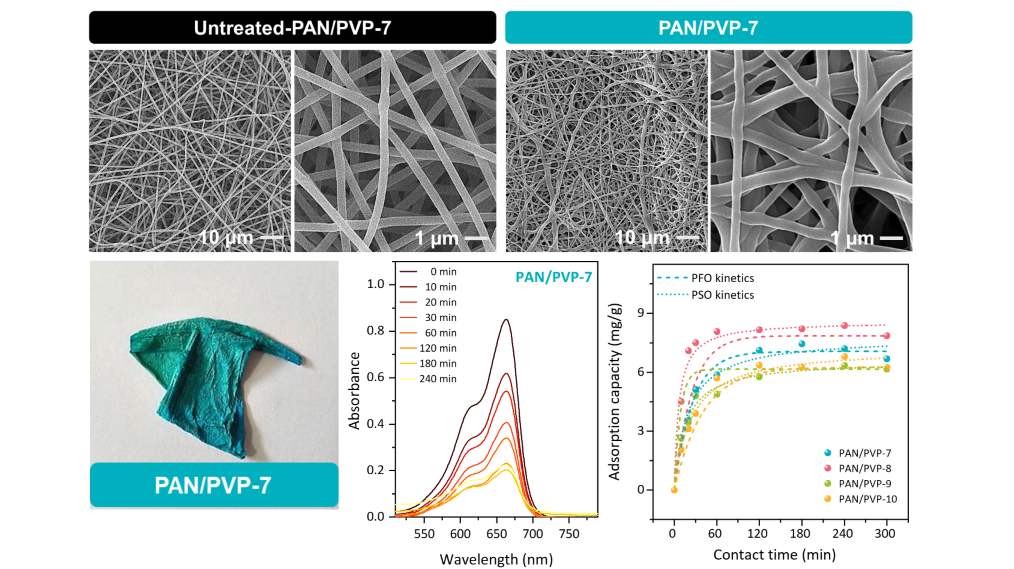
Synthetic dyes such as methylene blue (MB) and Congo red (CR) are persistent water pollutants requiring efficient removal. This study examines the effect of composition and morphology on the adsorption performance of electrospun polyacrylonitrile/polyvinylpyrrolidone (PAN/PVP) nanofiber membranes. PAN/PVP fibers with different PAN loadings (0.7–1.0 g, total polymer mass 1.3 g) were fabricated by electrospinning and subjected to hot-water soaking at 80 °C followed by thermal treatment at 200 °C. SEM and FTIR confirmed continuous nanofibrous networks containing both PAN and partially removed PVP, with only subtle morphological differences among compositions. Batch adsorption tests showed preferential uptake of MB over CR, with the highest MB capacity of 8.38 mg g<sup>−1</sup> obtained for the PAN/PVP-8 membrane and the highest CR capacity of 3.32 mg g<sup>−1</sup> obtained for the PAN/PVP-10 membrane, with only modest variation among the other ratios. Kinetic analysis revealed that MB and CR adsorption follow a pseudo-second-order model, indicating surface-controlled uptake and suggesting that further improvement will require targeted surface functionalization.Keywords
PAN/PVP nanofibers
electrospinning
morphology
dye adsorption
methylene blue
congo red
wastewater treatment
References
- 1. Sudarshan S., Harikrishnan S., RathiBhuvaneswari G., Alamelu V., Aanand S., Rajasekar A., Govarthanan M.. Impact of textile dyes on human health and bioremediation of textile industry effluent using microorganisms: current status and future prospects. Journal of Applied Microbiology. 2023;134:lxac064. https://doi.org/10.1093/jambio/lxac064
- 2. Silina A., El Achari A., Salaün F.. Metal-organic framework electrospun nanofibers in application to dye removal from textile wastewaters: A review. Journal of Environmental Chemical Engineering. 2024;12:114819. https://doi.org/10.1016/j.jece.2024.114819
- 3. Dhruv Patel D., Bhatt S.. Environmental pollution, toxicity profile, and physico-chemical and biotechnological approaches for treatment of textile wastewater. Biotechnology and Genetic Engineering Reviews. 2022;38:33-86. https://doi.org/10.1080/02648725.2022.2048434
- 4. Donkadokula N.Y., Kola A.K., Naz I., Saroj D.. A review on advanced physico-chemical and biological textile dye wastewater treatment techniques. Reviews in Environmental Science and Bio/Technology. 2020;19:543-560. https://doi.org/10.1007/s11157-020-09543-z
- 5. Hao Y.S., Othman N., Zaini M.A.A.. Methylene blue and Congo red removal by activated carbons: A current literature, Acta Universitatis Sapientiae. Agriculture and Environment. 2022;14:29-44. https://doi.org/10.2478/ausae-2022-0003
- 6. Vedula S.S., Yadav G.D.. Wastewater treatment containing methylene blue dye as pollutant using adsorption by chitosan lignin membrane: Development of membrane, characterization and kinetics of adsorption. Journal of the Indian Chemical Society. 2022;99:100263. https://doi.org/10.1016/j.jics.2021.100263
- 7. Dissanayake N.S.L., Pathirana M.A., Wanasekara N.D., Mahltig B., Nandasiri G.K.. Removal of Methylene Blue and Congo Red Using a Chitosan–Graphene Oxide-Electrosprayed Functionalized Polymeric Nanofiber Membrane. Nanomaterials. 2023;13:1350. https://doi.org/10.3390/nano13081350
- 8. Dutta S., Gupta B., Srivastava S.K., Gupta A.K.. Recent advances on the removal of dyes from wastewater using various adsorbents: a critical review. Materials Advances. 2021;2:4497-4531. https://doi.org/10.1039/d1ma00354b
- 9. Hamad H.N., Idrus S.. Recent Developments in the Application of Bio-Waste-Derived Adsorbents for the Removal of Methylene Blue from Wastewater: A Review. Polymers. 2022;14:783. https://doi.org/10.3390/polym14040783
- 10. Murphy O.P., Vashishtha M., Palanisamy P., Kumar K.V.. A Review on the Adsorption Isotherms and Design Calculations for the Optimization of Adsorbent Mass and Contact Time. ACS Omega. 2023;8:17407-17430. https://doi.org/10.1021/acsomega.2c08155
- 11. Pathirana M.A., Dissanayake N.S.L., Wanasekara N.D., Mahltig B., Nandasiri G.K.. Chitosan-Graphene Oxide Dip-Coated Polyacrylonitrile-Ethylenediamine Electrospun Nanofiber Membrane for Removal of the Dye Stuffs Methylene Blue and Congo Red. Nanomaterials. 2023;13:498. https://doi.org/10.3390/nano13030498
- 12. Fakhry H., El-Sonbati M., Omar B., El-Henawy R., Zhang Y., EL-Kady M.. Novel fabricated low-cost hybrid polyacrylonitrile/polyvinylpyrrolidone coated polyurethane foam (PAN/PVP@PUF) membrane for the decolorization of cationic and anionic dyes. Journal of Environmental Management. 2022;315:115128. https://doi.org/10.1016/j.jenvman.2022.115128
- 13. S. T. M., Arshad A.B., Lin P.T., Widakdo J., M. H. K., Austria H.F.M., Hu C.C., Lai J.Y., Hung W.S.. A review of recent progress in polymeric electrospun nanofiber membranes in addressing safe water global issues. RSC Advances. 2021;11:9638-9663. https://doi.org/10.1039/d1ra00060h
- 14. Rianjanu A., Marpaung K.D.P., Melati E.K.A., Aflaha R., Wibowo Y.G., Mahendra I.P., Yulianto N., Widakdo J., Triyana K., Wasisto H.S., Taher T.. Integrated adsorption and photocatalytic removal of methylene blue dye from aqueous solution by hierarchical Nb2O5@PAN/PVDF/ANO composite nanofibers. Nano Materials Science. 2024;6:96-105. https://doi.org/10.1016/j.nanoms.2023.10.006
- 15. Aflaha R., Afiyanti H., Azizah Z.N., Khoirudin H., Rianjanu A., Kusumaatmaja A., Roto R., Triyana K.. Improving ammonia sensing performance of quartz crystal microbalance (QCM) coated with nanofibers and polyaniline (PANi) overlay. Biosensors and Bioelectronics: X. 2023;13:100300. https://doi.org/10.1016/j.biosx.2022.100300
- 16. Aflaha R., Putri L.A., Maharani C.N., Rianjanu A., Roto R., Wasisto H.S., Triyana K.. Tuning a Superhydrophobic Surface on an Electrospun Polyacrylonitrile Nanofiber Membrane by Polysulfone Blending. ACS Omega. 2024;9:29840-29847. https://doi.org/10.1021/acsomega.4c03554
- 17. Aflaha R., Maharani C.N., Putri L.A., Prabowo Y.D., Rahman I., Taher T., Rianjanu A., Roto R., Wasisto H.S., Triyana K.. A superhydrophobic and heat-resistant PAN/PSU/PTFE composite nanofiber membrane for high-efficiency PM _1.0 and PM _2.5 filtration. Materials Advances. 2024;5:9731-9743. https://doi.org/10.1039/D4MA00841C
- 18. Aflaha R., Putri L.A., Farrel A., Anzinger S., Rianjanu A., Yulianto N., Fueldner M., Roto R., Peiner E., Wasisto H.S., Triyana K.. Crafting high-temperature stable and hydrophobic nanofiber membranes for particulate matter filtration. Communications Materials. 2025;6:87. https://doi.org/10.1038/s43246-025-00799-y
- 19. Katriani L., Aflaha R., Maharani C.N., Naafi’ah Salsabila F., As’ari A.H., Rianjanu A., Nurwantoro P., Roto R., Triyana K.. Quartz Crystal Microbalance Coated with a Polyvinylpyrrolidone Microfiber Active Layer as a High-Performance Acetic Acid Gas Sensor. Langmuir. 2025;41:4632-4640. https://doi.org/10.1021/acs.langmuir.4c04474
- 20. Aflaha R., Putri E.N.S., Maharani C.N., Katriani L., As’ari A.H., Rianjanu A., Putri W.B.K., Triyana K., Gupta R., Roto R.. QCM-based ammonia gas sensors with electrospun polymer-based nanofibers for liver and kidney disease detection: a mini-review. Journal of Materials Chemistry B. 2025;13:13589-13607. https://doi.org/10.1039/D5TB00842E
- 21. Zhou G., Jiang L., Chen G., Ma Y., Wang Y., Liu R.. Electrospun porous polyacrylonitrile/polyvinylpyrrolidone nanofiber membrane with ultra-hydrophilic and high moisture-permeability for dust personal protection. Journal of Environmental Chemical Engineering. 2024;12:113524. https://doi.org/10.1016/j.jece.2024.113524
- 22. Kang Y., Chen J., Feng S., Zhou H., Zhou F., Low Z.X., Zhong Z., Xing W.. Efficient removal of high-temperature particulate matters via a heat resistant and flame retardant thermally-oxidized PAN/PVP/SnO2 nanofiber membrane. Journal of Membrane Science. 2022;662:120985. https://doi.org/10.1016/j.memsci.2022.120985
- 23. Wu H., Wang Y., Zhang X., Xing W., Li L., Wang H., Huang L., Tang J.. PAN/ CB spheres modified PAN/PVP dual amphiphilic porous nanofiber membranes for high-performance oil-water separation. Colloids and Surfaces A: Physicochemical and Engineering Aspects. 2025;726:137768. https://doi.org/10.1016/j.colsurfa.2025.137768
- 24. Mahmood O.A.A.Q., Waisi B.I.. Crystal violet dye removal from aqueous water using polyacrylonitrile precursor beads. Materials Today: Proceedings. 2021;42:2185-2192. https://doi.org/10.1016/j.matpr.2020.12.303
- 25. Chokki J., Darracq G., Poelt P., Baron J., Gallard H., Joyeux M., Teychené B.. Investigation of Poly(ethersulfone)/Polyvinylpyrrolidone ultrafiltration membrane degradation by contact with sodium hypochlorite through FTIR mapping and two-dimensional correlation spectroscopy. Polymer Degradation and Stability. 2019;161:131-138. https://doi.org/10.1016/j.polymdegradstab.2019.01.017
- 26. Wang F., Zhang Z., Yan Y., Shen Z., Wang Q., Gerhard R.. Surface Reconstruction on Electro-Spun PVA/PVP Nanofibers by Water Evaporation. Nanomaterials. 2022;12:797. https://doi.org/10.3390/nano12050797
- 27. Mohammad N., Atassi Y.. Adsorption of methylene blue onto electrospun nanofibrous membranes of polylactic acid and polyacrylonitrile coated with chloride doped polyaniline. Scientific Reports. 2020;10:13412. https://doi.org/10.1038/s41598-020-69825-y
- 28. Ulfa M., Oktaviani S.L., Mulyani B., Sholeha N.A.. Metal Oxide for Fast Adsorption System in the Methylene Blue Removal. Indonesian Journal of Chemistry. 2025;25:619. https://doi.org/10.22146/ijc.92617
- 29. Bakar N.A., Othman N., Yunus Z.M., Altowayti W.A.H., Tahir M., Fitriani N., Mohd-Salleh S.N.A.. An insight review of lignocellulosic materials as activated carbon precursor for textile wastewater treatment. Environmental Technology & Innovation. 2021;22:101445. https://doi.org/10.1016/j.eti.2021.101445
- 30. Wang J., Guo X.. Adsorption kinetics and isotherm models of heavy metals by various adsorbents: An overview. Critical Reviews in Environmental Science and Technology. 2023;53:1837-1865. https://doi.org/10.1080/10643389.2023.2221157
- 31. Largitte L., Pasquier R.. A review of the kinetics adsorption models and their application to the adsorption of lead by an activated carbon. Chemical Engineering Research and Design. 2016;109:495-504. https://doi.org/10.1016/j.cherd.2016.02.006
- 32. Ali D.A., Abdalla F.M., Gamil D.A., Elsawy H.A.. Isotherm and kinetics studies for the adsorption of methylene blue and methyl red dyes from aqueous solutions using chitosan. ARPN J. Eng. Appl. Sci.. 2021;16:732-741.
- 33. Zhang L., Yang L., Chen J., Yin W., Zhang Y., Zhou X., Gao F., Zhao J.. Adsorption of Congo Red and Methylene Blue onto Nanopore-Structured Ashitaba Waste and Walnut Shell-Based Activated Carbons: Statistical Thermodynamic Investigations, Pore Size and Site Energy Distribution Studies. Nanomaterials. 2022;12:3831. https://doi.org/10.3390/nano12213831
- 34. Soleimani Fard M., Samadani Langeroodi N., Javan M., Dehno Khalaji A.. The Removal of Methylene Blue from Aqueous Solutions Using CuFe_2O_4/PVP Nanocomposite: An Experimental and Theoretical Study. Iranian Journal of Soil and Water Research. 2025;55:2109-2124. https://doi.org/10.22059/ijswr.2024.379082.669764
- 35. Fatiatun, Bakar S.A., Mohamed A., Kusuma H.H., Muqoyyanah, Mohamat R., Kumar V.V., Ali K., Nuryadi R., Azis M.N.A., Ahmad M.K., Mamat M.H., Othman M.H.D.. High Methylene Blue Adsorption Efficiency of Cellulose Acetate-Based Electrospun Nanofiber Membranes Modified with Graphene Oxide and Zeolite. International Journal of Environmental Research. 2025;19:18. https://doi.org/10.1007/s41742-024-00683-6
- 36. Strebel A., Behringer M., Hilbig H., Machner A., Helmreich B.. Anionic azo dyes and their removal from textile wastewater through adsorption by various adsorbents: a critical review. Frontiers in Environmental Engineering. 2024;3:1347981. https://doi.org/10.3389/fenve.2024.1347981
- 37. Khan A., Arif M., Han Z., Xie Y., Ni C.. Mechanism and performances of methyl orange and Congo red adsorption by MnO2–PVP composite. Water Practice & Technology. 2024;19:1047-1060. https://doi.org/10.2166/wpt.2024.032

Cite this:
Greensusmater.
2026, 3, 1, 05
Publication History
- Received: April 18, 2026
- Accepted: May 13, 2026
- Published: May 25, 2026
DOI: 10.62755/gsm.2026.05
Copyright © 2026 | The Authors. This publication is licensed under
CC-BY 4.0.
Published by Green and Sustainable Materials Society.
Article Views
192
Downloads
0
Citations
Graphical Abstract
Cite
ACM
[1]
Hanifah, I. et al. 2026. Effect of Composition and Morphology of Electrospun Polyacrylonitrile/Polyvinylpyrrolidone (PAN/PVP) Nanofibers on Adsorption of Methylene Blue and Congo Red Dyes. Greensusmater. 3, 1 (May 2026), 05. DOI:https://doi.org/10.62755/gsm.2026.05.
ACS
(1)
Hanifah, I.; Tobing, A. T. L.; Simamora, H. R. P.; Fitri, A.; Phasa, A. Effect of Composition and Morphology of Electrospun Polyacrylonitrile Polyvinylpyrrolidone (PAN PVP) Nanofibers on Adsorption of Methylene Blue and Congo Red Dyes. greensusmater 2026, 3, 05.
APA
Hanifah, I., Tobing, A. T. L., Simamora, H. R. P., Fitri, A., & Phasa, A. (2026). Effect of Composition and Morphology of Electrospun Polyacrylonitrile/Polyvinylpyrrolidone (PAN/PVP) Nanofibers on Adsorption of Methylene Blue and Congo Red Dyes. Greensusmater, 3(1), 05. https://doi.org/10.62755/gsm.2026.05
ABNT
HANIFAH, Istiara; TOBING, Alex Triputra Lumban; SIMAMORA, Hanna Ronauli Permata; FITRI, Anisa; PHASA, Agita. Effect of Composition and Morphology of Electrospun Polyacrylonitrile/Polyvinylpyrrolidone (PAN/PVP) Nanofibers on Adsorption of Methylene Blue and Congo Red Dyes. Greensusmater, [S. l.], v. 3, n. 1, p. 05, 2026. DOI: 10.62755/gsm.2026.05. Disponível em: https://greensusmater.com/gsm/article/view/66. Acesso em: 30 sep. 2026.
Chicago
Hanifah, Istiara, Alex Triputra Lumban Tobing, Hanna Ronauli Permata Simamora, Anisa Fitri, and Agita Phasa. 2026. “Effect of Composition and Morphology of Electrospun Polyacrylonitrile Polyvinylpyrrolidone (PAN PVP) Nanofibers on Adsorption of Methylene Blue and Congo Red Dyes”. Greensusmater 3 (1):05. https://doi.org/10.62755/gsm.2026.05.
Harvard
Hanifah, I. (2026) “Effect of Composition and Morphology of Electrospun Polyacrylonitrile/Polyvinylpyrrolidone (PAN/PVP) Nanofibers on Adsorption of Methylene Blue and Congo Red Dyes”, Greensusmater, 3(1), p. 05. doi: 10.62755/gsm.2026.05.
IEEE
[1]
I. Hanifah, A. T. L. Tobing, H. R. P. Simamora, A. Fitri, and A. Phasa, “Effect of Composition and Morphology of Electrospun Polyacrylonitrile/Polyvinylpyrrolidone (PAN/PVP) Nanofibers on Adsorption of Methylene Blue and Congo Red Dyes”, greensusmater, vol. 3, no. 1, p. 05, May 2026.
MLA
Hanifah, Istiara, et al. “Effect of Composition and Morphology of Electrospun Polyacrylonitrile Polyvinylpyrrolidone (PAN PVP) Nanofibers on Adsorption of Methylene Blue and Congo Red Dyes”. Greensusmater, vol. 3, no. 1, May 2026, p. 05, doi:10.62755/gsm.2026.05.
Turabian
Hanifah, Istiara, Alex Triputra Lumban Tobing, Hanna Ronauli Permata Simamora, Anisa Fitri, and Agita Phasa. “Effect of Composition and Morphology of Electrospun Polyacrylonitrile Polyvinylpyrrolidone (PAN PVP) Nanofibers on Adsorption of Methylene Blue and Congo Red Dyes”. Greensusmater 3, no. 1 (May 25, 2026): 05. Accessed September 30, 2026. https://greensusmater.com/gsm/article/view/66.
Vancouver
1.
Hanifah I, Tobing ATL, Simamora HRP, Fitri A, Phasa A. Effect of Composition and Morphology of Electrospun Polyacrylonitrile/Polyvinylpyrrolidone (PAN/PVP) Nanofibers on Adsorption of Methylene Blue and Congo Red Dyes. greensusmater [Internet]. 2026 May 25 [cited 2026 Sep. 30];3(1):05. Available from: https://greensusmater.com/gsm/article/view/66